
Gut Health and Skin: How Your Gut Affects Acne and Eczema
If you’ve spent years treating your skin from the outside — cycling through cleansers, serums, prescriptions, and elimination diets — and still can’t get clear, consistent results, there’s a question worth asking that most dermatologists still don’t raise.
What’s happening in your gut?
The connection between gut health and skin conditions isn’t new science. Dermatologists in the 1930s proposed a gut-skin axis — a link between digestive health and inflammatory skin conditions — long before the microbiome became a research priority. What’s new is the quality and volume of evidence now supporting that connection, and the specificity with which researchers can describe exactly how your gut drives what shows up on your face.
Acne. Eczema. Rosacea. Psoriasis. These aren’t purely skin conditions. In a significant proportion of people who have them, they’re skin manifestations of gut dysfunction — and treating only the skin while ignoring the gut is why so many people cycle endlessly through treatments that work temporarily and then stop.
This article explains the gut-skin axis in practical, actionable terms — what the research shows, which gut factors drive which skin conditions, and what you can actually do about it.
Quick Reference: Gut-Skin Connection at a Glance
| Skin Condition | Gut Link | Key Research Finding |
|---|---|---|
| Acne | SIBO, dysbiosis, leaky gut | Acne patients have significantly lower Lactobacillus and Bifidobacterium |
| Eczema (Atopic Dermatitis) | Microbiome imbalance, low diversity | Reduced diversity in infancy predicts eczema development |
| Rosacea | SIBO, H. pylori | Treating SIBO produces rosacea improvement in 96% of affected patients |
| Psoriasis | Dysbiosis, leaky gut, inflammation | Psoriasis patients show distinct microbiome composition vs controls |
| Acne Rosacea | Intestinal permeability | Leaky gut markers elevated in rosacea patients |
| General skin inflammation | LPS from leaky gut | Gut-derived endotoxins drive skin inflammatory pathways |
The Gut-Skin Axis: What It Actually Means
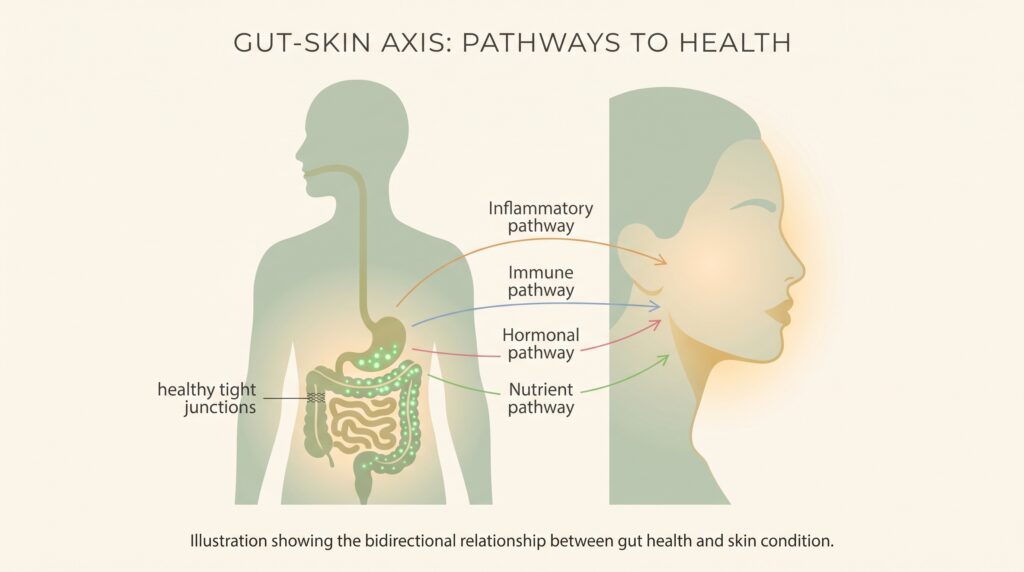
Your gut and your skin are more connected than their physical distance suggests.
Both are barrier organs — their primary function is to separate your internal environment from the external world while selectively allowing beneficial exchanges. Significant immune activity happens in each of them. They also share a direct line of communication with your brain through the nervous system. And both are profoundly influenced by the state of your gut microbiome.
The connection works through several overlapping pathways.
The inflammatory pathway is the most direct. When gut dysbiosis leads to increased intestinal permeability — what researchers call leaky gut — bacterial fragments called lipopolysaccharides (LPS) from gram-negative bacteria enter the bloodstream. Your immune system responds to these fragments with systemic inflammation. That inflammation doesn’t stay in one place. It travels through the bloodstream and activates inflammatory responses in skin tissue, contributing to the redness, swelling, and breakout patterns characteristic of inflammatory skin conditions.
The immune pathway is equally important. Approximately 70% of your immune system lives in gut-associated lymphoid tissue. The state of your gut microbiome directly trains and modulates immune responses throughout your body — including the inflammatory immune responses that drive eczema, psoriasis, and acne. A diverse, balanced microbiome promotes calibrated immune responses. A depleted microbiome promotes dysregulated ones.
The hormonal pathway connects gut health to the hormonal drivers of acne specifically. Gut bacteria regulate estrogen metabolism through an enzyme called beta-glucuronidase. When certain bacterial strains overproduce this enzyme, estrogen that should be excreted gets reactivated and recirculated — contributing to the hormonal fluctuations that drive adult hormonal acne, particularly in women.
The nutrient pathway operates through gut absorption. Zinc, vitamin A, omega-3 fatty acids, and vitamin D are all essential for healthy skin function and all require adequate gut absorption to reach skin tissue at meaningful concentrations. A damaged or dysbiotic gut absorbs these nutrients poorly — creating deficiencies that manifest on the skin even when dietary intake is adequate.
If you haven’t yet identified broader gut dysfunction beyond skin symptoms, read: 10 Signs You Have an Unhealthy Gut (And How to Fix It)
Acne and the Gut
Acne is the most common skin condition in the United States, affecting approximately 50 million Americans annually. It’s also the skin condition with the most accumulated research on gut connections.
What the research shows
A 2011 study published in Gut Pathogens found that patients with acne had significantly lower levels of Lactobacillus acidophilus and Lactobacillus bulgaricus compared to clear-skinned controls — and that probiotic supplementation with these strains produced measurable improvements in acne severity within 12 weeks.
A 2016 review in the Journal of Clinical and Aesthetic Dermatology analyzed the evidence on gut-skin connections in acne and concluded that gut microbiome imbalance, increased intestinal permeability, and gut-derived inflammation all contribute to acne pathogenesis — and that targeting gut health represents a meaningful adjunct to conventional acne treatment.
Perhaps most striking: a 2018 study found that people with acne had significantly higher rates of small intestinal bacterial overgrowth (SIBO) than clear-skinned controls — and that treating SIBO improved acne in the majority of affected patients. The gut connection in acne isn’t speculative. It’s documented across multiple research groups.
The specific gut mechanisms driving acne
Excess androgen recirculation — the gut-estrogen connection mentioned earlier applies equally to androgen metabolism. Gut dysbiosis can increase the circulation of androgens that stimulate sebaceous gland activity and contribute to the comedonal and inflammatory acne pattern.
Gut-derived inflammation activating P. acnes — Cutibacterium acnes (formerly Propionibacterium acnes), the bacteria most associated with acne, doesn’t cause breakouts in everyone who has it on their skin. What activates it into an inflammatory pathogen is an inflammatory environment — which gut dysbiosis creates systemically.
Leaky gut and skin permeability — research has found that people with acne also tend to have increased skin barrier permeability. The same inflammatory signals that compromise the gut barrier appear to compromise the skin barrier, creating conditions in which normally harmless bacteria trigger breakouts.
What helps
Probiotic supplementation with Lactobacillus-dominant formulas has the strongest evidence for acne improvement through the gut pathway. Reducing high-glycemic foods — which promote dysbiosis and androgen activity simultaneously — addresses both gut and hormonal contributors. Zinc supplementation supports both gut lining integrity and has direct anti-inflammatory effects in skin tissue. Omega-3 fatty acids reduce the gut-derived inflammation that creates the permissive environment for acne development.
Eczema and the Gut
Eczema — or atopic dermatitis — is a chronic inflammatory skin condition affecting approximately 31 million Americans. The gut connection in eczema is perhaps better established than in any other skin condition, because it begins before birth.
What the research shows
The most compelling evidence for the gut-eczema connection comes from infant microbiome studies. A landmark 2007 study published in the Journal of Allergy and Clinical Immunology found that infants who developed eczema had significantly lower gut microbiome diversity in their first weeks of life compared to those who remained clear — before any skin symptoms had appeared. The microbiome disruption preceded the skin condition, not the other way around.
A 2020 Cochrane systematic review — the gold standard of evidence synthesis — analyzed 39 randomized controlled trials on probiotics for eczema prevention and treatment. It found that probiotic supplementation in pregnant women and infants significantly reduced the risk of eczema development in high-risk children, and that treatment with Lactobacillus rhamnosus GG specifically produced significant reductions in eczema severity scores in affected children and adults.
Research from King’s College London found that the composition of gut microbiota in the first year of life directly predicts eczema risk at age four — with lower Bacteroidetes and higher Firmicutes ratios in infancy associated with significantly higher eczema rates in early childhood.
The specific gut mechanisms driving eczema
Th2 immune polarization — eczema is fundamentally an immune condition in which the immune system is polarized toward an overactive Th2 response (the “allergy” immune pathway). Gut microbiome diversity in early life is the primary driver of immune system education toward a balanced Th1/Th2 response. Disrupted microbiome diversity in infancy allows Th2 polarization to develop unchecked, creating the immunological foundation for eczema.
Leaky gut and allergen sensitization — when gut barrier integrity is compromised, food proteins and environmental antigens that would normally be excluded can enter the bloodstream and trigger immune sensitization. This sensitization to otherwise harmless antigens is a central feature of atopic dermatitis.
Staph aureus and microbiome interaction — Staphylococcus aureus overgrowth on eczema-affected skin is strongly associated with flare severity. Research has shown that gut microbiome composition influences skin microbiome composition — a diverse, Lactobacillus-rich gut is associated with more balanced skin microbiome that limits S. aureus colonization.
What helps
The evidence for Lactobacillus rhamnosus GG in eczema is among the strongest for any probiotic in any condition — multiple randomized controlled trials showing significant symptom reduction. Diversifying gut microbiome through dietary means — fermented foods, increased plant diversity, reduced ultra-processed food — addresses the dysbiosis driving immune dysregulation. Vitamin D supplementation has specific evidence for eczema improvement through its role in immune regulation and skin barrier function.
Rosacea and the Gut
Rosacea — the chronic facial redness, flushing, and inflammatory bumps affecting approximately 16 million Americans — has perhaps the most direct and dramatic gut connection of any skin condition.
What the research shows
In 2008, Italian researchers published a study in the journal Dermatology that has become one of the most cited in the gut-skin literature. They screened 113 rosacea patients for SIBO using the hydrogen breath test and found that 46% of them had SIBO — compared to 5% of healthy controls. They then treated the SIBO-positive rosacea patients with rifaximin (an antibiotic specific to the small intestine) and followed them for nine months.
The results were striking: 96% of rosacea patients who had SIBO showed significant improvement in rosacea symptoms after SIBO treatment. Nearly half achieved complete remission. A year and a half later, patients whose SIBO had not returned maintained their skin improvement. Those whose SIBO recurred saw their rosacea return.
This is not a peripheral association. In nearly half of rosacea patients studied, small intestinal bacterial overgrowth appears to be a primary driver of the condition — not just a correlate.
Separate research has found elevated markers of intestinal permeability in rosacea patients, and H. pylori infection has been associated with rosacea in multiple studies — with H. pylori eradication producing skin improvement.
What helps
Anyone with rosacea who hasn’t been evaluated for SIBO is missing a potentially critical piece of their treatment picture. SIBO testing (hydrogen breath test) is straightforward and non-invasive. Beyond SIBO, reducing gut inflammation through dietary means — anti-inflammatory foods, fermented foods, reduced alcohol and spicy foods that trigger both gut and skin vasodilation — addresses multiple rosacea drivers simultaneously.
Psoriasis and the Gut
Psoriasis — the autoimmune skin condition characterized by rapid skin cell proliferation and plaque formation — is increasingly understood as a systemic inflammatory condition with significant gut involvement.
What the research shows
Multiple studies have found that psoriasis patients have a distinct gut microbiome composition compared to healthy controls — characterized by reduced Faecalibacterium prausnitzii (a key anti-inflammatory butyrate producer), reduced Akkermansia muciniphila, and altered Firmicutes/Bacteroidetes ratios. These changes parallel the microbiome changes seen in inflammatory bowel disease — which co-occurs with psoriasis at significantly higher rates than chance would predict.
A 2019 study in JAMA Dermatology found that psoriasis patients with concurrent gut symptoms showed more severe skin disease than those without gut involvement — suggesting that addressing gut inflammation directly reduces the systemic inflammatory burden driving psoriatic skin activity.
What helps
The dietary approaches with the strongest evidence for psoriasis improvement target both gut inflammation and the systemic inflammatory environment: Mediterranean-style diet, omega-3 supplementation, reduction of processed food and alcohol, and vitamin D. Emerging research on the role of Akkermansia muciniphila specifically in psoriasis suggests that dietary approaches promoting this species — polyphenol-rich foods including pomegranate, cranberry, and green tea — may have specific relevance.
Practical Steps: Healing Your Gut for Clearer Skin

Understanding the connection is the beginning. Here’s what the evidence supports in practice.
1. Add fermented foods daily
Lactobacillus-dominant fermented foods — kefir, plain yogurt with live cultures, sauerkraut — directly address the bacterial deficiencies most consistently associated with inflammatory skin conditions. Daily consumption is more effective than occasional large amounts.
2. Diversify plant intake
Microbiome diversity is protective against the immune dysregulation that drives eczema, psoriasis, and inflammatory acne. Aim for 25–30 different plant foods weekly. Each new plant food feeds a different bacterial population and contributes to the diversity that calibrates immune responses.
3. Reduce high-glycemic foods
High-glycemic foods spike insulin and IGF-1, which stimulate sebaceous gland activity and androgen production — key drivers of acne. They also promote dysbiosis by selectively feeding harmful bacterial species. Reducing refined carbohydrates addresses both the gut and hormonal contributors to acne simultaneously.
4. Address gut lining integrity
For skin conditions driven by leaky gut — rosacea, inflammatory acne, psoriasis — gut lining repair is a direct treatment target. L-glutamine (5 grams daily on an empty stomach), bone broth, collagen peptides, and zinc carnosine all support tight junction integrity and reduce the bacterial fragment translocation that drives systemic skin inflammation.
For a detailed explanation of leaky gut treatment, read: What Is Leaky Gut Syndrome? Symptoms, Causes and How to Heal
5. Consider targeted probiotic supplementation
For acne, Lactobacillus acidophilus and Lactobacillus bulgaricus have specific published evidence. Eczema responds best to Lactobacillus rhamnosus GG (LGG), which has the most robust evidence base of any single strain for this condition. General gut-skin support is best covered by a multi-strain formula with multiple Lactobacillus and Bifidobacterium species, which addresses the broadest range of skin-relevant mechanisms.
💊 Editor’s Pick: Will Silva’s top probiotic recommendation on Amazon (affiliate link — independently researched)
6. Eliminate common gut-skin triggers
Alcohol directly damages gut barrier integrity and triggers both gut inflammation and skin vasodilation — a double driver of rosacea and general skin reactivity. Dairy products trigger acne in a subset of people through IGF-1 elevation and androgen activity — worth eliminating for 4 weeks if hormonal acne is a significant issue. Ultra-processed foods with emulsifiers damage the gut barrier and drive the systemic inflammation that manifests on skin.
7. Test for SIBO if rosacea is a concern
Given the 46% SIBO prevalence in rosacea patients and the dramatic improvement seen with SIBO treatment, anyone with persistent rosacea should discuss SIBO testing with a gastroenterologist or functional medicine practitioner. A hydrogen breath test is non-invasive and may identify a treatable root cause that conventional rosacea treatment doesn’t address.
The Timeline for Gut-Skin Improvement
Skin improvement through gut health interventions follows a predictable but slower timeline than topical treatments — which is the main reason people abandon the approach prematurely.
Weeks 1–3: Gut inflammation begins to reduce. Some people notice reduced skin redness and fewer new breakouts during this window, though it’s not universal this early.
Weeks 3–8: Microbiome composition begins to shift meaningfully. The inflammatory burden driving skin reactivity starts to decrease. Most people notice some improvement in their baseline skin condition — fewer flares, reduced redness, less severe breakouts when they occur.
Months 2–4: Gut lining repair and sustained microbiome diversity improvements produce more significant skin changes. This is typically when people notice consistent, sustained improvement rather than the variable day-to-day skin they’re used to.
Beyond 4 months: The changes become more stable and self-reinforcing. A healthier gut microbiome is less reactive to the stressors — dietary, emotional, hormonal — that previously triggered skin flares.
Patience in this window is essential. The gut-skin axis operates on biological timescales that don’t match the expectation set by topical treatments. What it offers in exchange is improvement that addresses root cause rather than surface symptom.
The Bottom Line
Your skin is a mirror of your gut. Not in every case, not for every condition, and not to the exclusion of other contributing factors. But in a significant proportion of people with inflammatory skin conditions — acne, eczema, rosacea, psoriasis — gut dysfunction is a primary or significant contributing driver that conventional dermatological treatment never addresses.
The research on this is no longer preliminary. The gut-skin axis is documented, mechanistically understood, and increasingly integrated into functional and integrative dermatology practice. The people who benefit most are those who approach their skin condition as a whole-body problem rather than a surface-level one.
If you’ve been treating your skin from the outside for years without lasting results, the next treatment worth trying might be internal.
→ Read next: How to Improve Your Gut Microbiome Naturally (7 Proven Ways)
→ Also read: Best Foods for a Healthy Gut: The Complete Quick Guide
Frequently Asked Questions
Q: Can healing your gut really clear acne? A: For a subset of people with acne — particularly those with gut dysbiosis, SIBO, or leaky gut as a contributing factor — yes, meaningfully. Multiple randomized controlled trials have found that probiotic supplementation and dietary interventions targeting gut health produce significant acne improvement. Results vary depending on what’s driving the acne in a given individual.
Q: How long does it take for gut health changes to improve skin? A: Most people notice initial improvement within 4–8 weeks of consistent dietary changes targeting gut health. More significant and sustained skin improvement typically develops over 3–4 months. The timeline is slower than topical treatments but the improvements tend to be more durable.
Q: Does dairy cause acne through the gut? A: Dairy affects acne through multiple pathways — IGF-1 elevation, androgen stimulation, and in some people, gut microbiome disruption from lactose or dairy proteins. The gut pathway is one of several mechanisms. Eliminating dairy for 4–6 weeks is a practical way to assess whether it’s a significant driver for you individually.
Q: Is eczema caused by gut bacteria? A: Gut microbiome composition in early life is a significant predictor of eczema development — so “caused by” is too simple, but gut bacteria are clearly a major factor. In adults with established eczema, gut microbiome interventions (particularly Lactobacillus rhamnosus GG) produce significant symptom improvement in clinical trials.
Q: Should I see a dermatologist or a gastroenterologist for gut-related skin issues? A: Ideally both — but finding a dermatologist who integrates gut health into their practice, or a functional medicine practitioner who addresses both systems, will be more productive than seeing them separately. A gastroenterologist is specifically appropriate if rosacea is your primary concern and SIBO testing is relevant.
References & Further Reading
- Bowe WP & Logan AC. “Acne vulgaris, probiotics and the gut-brain-skin axis.” Gut Pathogens, 2011.
- Drago F, et al. “Changing of the intestinal microbiota in rosacea patients.” Journal of the European Academy of Dermatology and Venereology, 2018.
- Parodi A, et al. “Small intestinal bacterial overgrowth in rosacea: clinical effectiveness of its eradication.” Dermatology, 2008.
- Huang R, et al. “Probiotics for the treatment of atopic dermatitis in children.” Frontiers in Cellular and Infection Microbiology, 2017.
- Schar MY, et al. “Gut microbiota composition is associated with future skin condition.” Journal of Allergy and Clinical Immunology, 2019.
- Vaughn AR, et al. “Skin-gut axis: The relationship between intestinal bacteria and skin health.” World Journal of Dermatology, 2017.
This article is for informational purposes only and does not constitute medical advice. Always consult a qualified healthcare professional for personal health concerns, including skin conditions.