
How to Do a Gut Reset in 30 Days (The Right Way)
The idea of a “reset” gets overused in wellness culture — detox teas, juice cleanses, 3-day protocols that promise to undo years of poor dietary habits in 72 hours.
This isn’t that.
A genuine gut reset isn’t a deprivation protocol. It doesn’t require you to stop eating, drink expensive powders, or follow a rigid elimination plan that’s impossible to sustain past day four. What it requires is a deliberate, structured 30-day commitment to the dietary and lifestyle inputs that the research consistently shows shift gut microbiome composition in meaningful, measurable ways.
Thirty days is enough time to produce real change. The microbiome responds to dietary inputs within 24 to 48 hours — which means four weeks of consistent positive inputs produces a genuinely different microbial landscape than what you started with. Not perfect. Not permanently transformed. But measurably improved — and, more importantly, equipped with the new habits that make continued improvement sustainable.
Here’s how to do it properly.
Quick Reference: 30-Day Gut Reset at a Glance
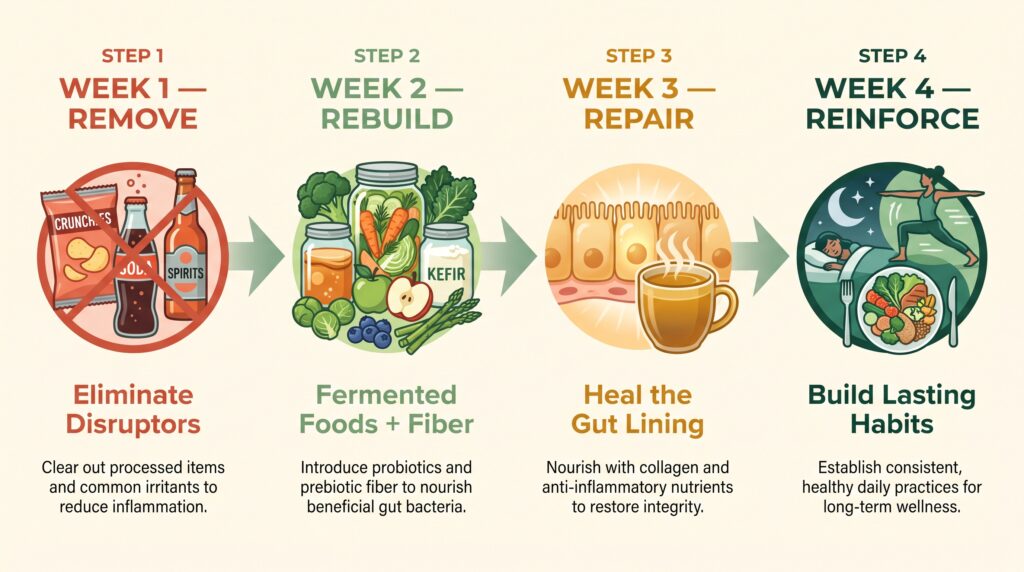
| Week | Focus | Primary Goal |
|---|---|---|
| Week 1 | Remove + Foundation | Eliminate gut disruptors, add basics |
| Week 2 | Rebuild | Fermented foods daily, prebiotic fiber |
| Week 3 | Repair | Gut lining support, anti-inflammatory foods |
| Week 4 | Reinforce | Full integration, build sustainable habits |
| Beyond 30 days | Maintain | Sustain the new baseline |
Before You Start: What a Gut Reset Actually Does

Your gut microbiome is not a fixed entity. It’s a dynamic, responsive ecosystem that shifts in composition based on what you eat, how you sleep, how stressed you are, and what medications you take.
The purpose of a structured 30-day reset is to systematically remove the inputs that promote dysbiosis while simultaneously adding the inputs that promote a diverse, balanced microbiome. You’re not detoxing anything. You’re changing the environment so the ecosystem can rebalance.
What you can realistically expect by day 30 with consistent implementation: reduced bloating and more regular digestion, improved energy — particularly in the afternoon, more stable mood and reduced anxiety, clearer thinking with less brain fog, reduced sugar cravings, better sleep quality, and in many people, visible improvements in skin clarity.
What you should not expect: a complete cure for chronic gut conditions, dramatic weight loss, or permanent transformation from 30 days alone. The reset is a foundation — a dramatically improved starting point from which longer-term habits can operate.
If you’re unclear on what gut imbalance looks like in your body specifically, read: 10 Signs You Have an Unhealthy Gut (And How to Fix It)
What to Remove Before Day 1
The first and most important step of any gut reset isn’t adding anything. It’s removing the inputs that continuously undermine gut health — because even the best probiotics and fermented foods can’t counteract an environment that’s actively hostile to beneficial bacteria.
Ultra-processed foods are the highest priority removal. This category — defined as foods manufactured with emulsifiers, artificial sweeteners, refined seed oils, preservatives, and refined carbohydrates — directly damages the gut’s protective mucus layer, promotes the growth of inflammatory bacterial species, and disrupts the Akkermansia muciniphila populations essential for gut barrier integrity. Read ingredient labels this week. If you see polysorbate 80, carrageenan, carboxymethylcellulose, or more than five ingredients you wouldn’t find in a home kitchen, put it back.
Refined sugar is the selective food source for the harmful bacteria and yeast overgrowth that drives bloating, gas, and dysbiosis. Removing it doesn’t mean removing fruit — whole fruit provides fiber alongside its natural sugars, which changes how it ferments in the gut entirely. It means removing added sugar from beverages, packaged foods, sauces, and snacks.
Alcohol directly damages gut lining cells and promotes gram-negative bacterial overgrowth. For the 30 days of this reset, removing it entirely produces more significant microbiome improvement than any other single dietary change for people who drink regularly.
Seed oils — canola, soybean, sunflower, corn oil — are high in omega-6 fatty acids that promote an inflammatory microbiome environment. Replace them with extra virgin olive oil, avocado oil, and grass-fed butter for the duration of the reset and beyond.
Week 1: Remove and Foundation (Days 1–7)
The first week focuses on clearing the deck — removing the primary gut disruptors — while laying the basic dietary foundation that the following weeks will build on.
Daily non-negotiables this week
Hydration: Two liters of filtered water daily. Your gut lining requires adequate hydration to produce the protective mucus layer that shields it from inflammatory insults. This sounds obvious but is consistently underdone.
One fermented food: Start small — two tablespoons of sauerkraut (unpasteurized, refrigerated) or a quarter cup of plain kefir daily. Your gut may not be accustomed to live cultures, and introducing too much too quickly can temporarily increase gas. Start conservative and build.
Vegetables at every meal: A minimum of two different vegetables at lunch and dinner. Variety matters as much as quantity — rotating between different vegetables feeds different bacterial species and begins building the plant diversity that the microbiome thrives on.
Eliminate the removal list above: Ultra-processed foods, refined sugar, alcohol, and seed oils come out this week. This is the hardest week for most people — particularly the sugar withdrawal, which peaks around days 3 to 5 and then diminishes.
What to expect in Week 1
Days 1–3 are often the roughest. Sugar cravings peak. Some people experience headaches, fatigue, or irritability as the gut microbiome shifts away from the species that were thriving on processed food. This is a sign that things are changing, not that the reset isn’t working.
By days 5–7, most people notice reduced bloating — often significantly so — as the fermentation of undigested processed food residue decreases. Energy begins to stabilize. Sleep may improve slightly.
Week 2: Rebuild (Days 8–14)
With the gut disruptors removed and the foundation established, Week 2 focuses on actively rebuilding the beneficial bacterial populations that dysbiosis had depleted.
Daily non-negotiables this week
Increase fermented foods to two servings daily: One serving of kefir or yogurt with live cultures (one cup) plus one serving of sauerkraut or kimchi (three to four tablespoons). By now your gut has had a week to begin adjusting to live cultures and can handle a larger daily dose.
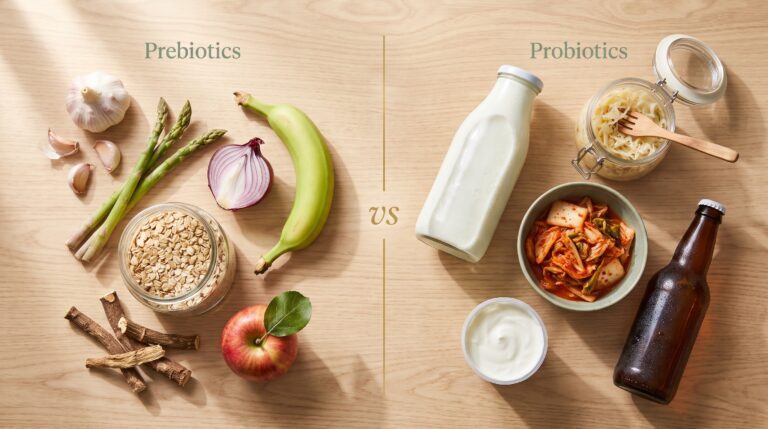
Prebiotic fiber at every meal: Garlic and onion in cooking, a green banana in your morning smoothie or oats, asparagus as a side dish at dinner, oats for breakfast. These foods feed the beneficial bacteria being introduced through fermented foods — without prebiotic fiber, even daily fermented food consumption has limited ability to establish lasting microbiome shifts.
30 plant foods target begins: Start tracking the number of different plant foods you eat across the week. Every vegetable, fruit, whole grain, legume, nut, seed, and herb counts as a separate plant food. Aim for 20 this week — a more realistic early target that most people can hit without dramatic dietary restructuring.
Add a quality probiotic supplement: A multi-strain probiotic taken with breakfast supports the dietary rebuilding happening this week. The combination of fermented foods, prebiotic fiber, and a quality supplement produces more significant microbiome shifts than any single approach alone.
💊 Editor’s Pick: Will Silva’s top probiotic recommendation on Amazon (affiliate link — independently researched)
What to expect in Week 2
Most people notice meaningful improvement in digestive regularity — more consistent bowel movements, reduced gas, and less post-meal bloating. The afternoon energy crash that many people experience begins to stabilize as blood sugar regulation improves without the processed food inputs driving earlier spikes and crashes.
Sugar cravings, which peaked in Week 1, typically diminish significantly by the end of Week 2. This reflects the actual shift in gut bacterial populations away from the strains that were producing craving-driving metabolic signals.
Week 3: Repair (Days 15–21)

By Week 3, the foundation is established and the rebuilding is underway. This week turns attention to the physical repair of the gut lining — the barrier that, when compromised, drives the systemic symptoms that extend beyond digestion into skin, mood, and immune function.
Daily non-negotiables this week
Bone broth daily: One to two cups of bone broth daily, drunk warm or used as a cooking base. Rich in L-glutamine, collagen, glycine, and proline — the structural building blocks of gut lining tissue. This is the week to make bone broth a daily ritual rather than an occasional addition.
L-glutamine supplementation: Five grams dissolved in water on an empty stomach each morning. L-glutamine is the primary energy source for intestinal epithelial cells and has the most direct published evidence for reducing intestinal permeability. It works best when taken consistently over three to four weeks — which is why Week 3 is the right time to introduce it.
Anti-inflammatory foods daily: Wild-caught salmon two to three times this week. Turmeric with black pepper in at least one meal daily. Extra virgin olive oil as your primary fat source. Blueberries or pomegranate in your breakfast. These foods reduce the gut inflammation that prevents the lining from repairing efficiently.
Omega-3 supplementation: One to three grams of combined EPA and DHA daily with your largest meal. Omega-3s reduce gut-derived inflammation and have specific evidence for increasing beneficial bacterial populations — a direct complement to the dietary rebuilding of Week 2.
Extend the plant diversity target to 25: By now, hitting 25 different plant foods per week should be achievable with intentional variety at each meal.
What to expect in Week 3
Week 3 is typically when people notice the changes that aren’t just digestive. Skin clarity often improves during this window — reduced inflammation systemically begins to show in reduced redness, fewer breakouts, and less puffiness. Mental clarity often sharpens. The gut-brain axis connection becomes tangible: people notice they feel calmer, more emotionally stable, and more mentally focused than the weeks preceding the reset.
Sleep quality frequently improves in Week 3 as serotonin production normalizes with a more balanced gut microbiome and the gut’s circadian rhythm restabilizes.
For more on the gut lining repair specifically, read: What Is Leaky Gut Syndrome? Symptoms, Causes and How to Heal
Week 4: Reinforce (Days 22–30)
The final week consolidates everything from the previous three weeks — not by adding more, but by refining what’s already working and building the sustainable habits that will extend the reset’s benefits well beyond day 30.
Daily non-negotiables this week
Full integration of all previous weeks: Fermented foods twice daily, prebiotic fiber at every meal, bone broth daily, L-glutamine each morning, anti-inflammatory foods and omega-3s, plant diversity of 25 to 30 different foods, quality probiotic supplement.
Stress management as a daily practice: By now the dietary foundation is solid. Week 4 is the time to address the other major input into gut health: stress. Chronic cortisol directly disrupts the microbiome — loosening tight junctions, reducing mucus production, and shifting bacterial populations toward more inflammatory species. Ten minutes of diaphragmatic breathing each morning has measurable effects on vagal tone and gut motility. A 20-minute walk after dinner improves both gut motility and stress hormones. These don’t need to be elaborate — they need to be consistent.
Sleep consistency: Commit to the same bedtime and wake time every day this week, including the weekend. Gut microbiome circadian rhythm is directly tied to sleep timing consistency — irregular sleep timing, even when total hours are adequate, disrupts microbial activity patterns and impairs the overnight gut repair process.
Assess and adjust: At the end of Week 4, take stock honestly. Which symptoms have improved most? Which haven’t shifted as much as expected? The answers guide whether Week 5 and beyond should continue what’s working or whether a specific issue — persistent SIBO, significant leaky gut, hormonal factors — warrants more targeted attention.
What to expect in Week 4
By day 30, most people report that the habits established during the reset feel significantly more natural than they did on Day 1. The fermented foods that felt foreign in Week 1 are now routine parts of meals. The processed food that was a daily fixture now has less appeal — not through willpower, but because the gut bacterial populations that were generating cravings for it have been substantially reduced.
The physical improvements that began emerging in Weeks 2 and 3 are now more stable and consistent. Better digestion, more energy, clearer skin, more stable mood — these are the measurable outputs of a microbiome that has meaningfully shifted toward balance.
Beyond Day 30: Making It Stick
The 30-day reset produces real results — but the gut microbiome doesn’t maintain improvements automatically. The environment you provide it going forward determines whether the gains you made are sustained or gradually reversed.
The most important insight from microbiome research on long-term maintenance: you don’t need to maintain the same intensity as the reset. You need to maintain the same direction.
A daily serving of fermented food, consistent plant diversity of 25 to 30 weekly, reduced ultra-processed food as a default rather than an exception, adequate sleep, and managed stress — sustained over months and years — produces the cumulative microbiome diversity that’s associated with long-term health outcomes in the research.
The reset gives you the starting position. The habits give you the trajectory. And the trajectory, sustained consistently, is where the real and lasting gut health benefits live.
Common Questions About the 30-Day Gut Reset
Q: Do I need to buy expensive supplements to do this reset? A: No. The dietary changes — removing processed food, adding fermented foods and plant diversity — produce the most significant microbiome changes. A quality probiotic supplement accelerates results but is optional for people on a tight budget. L-glutamine and omega-3s are useful additions but not required to see meaningful improvement from the dietary protocol alone.
Q: What if I slip up during the 30 days? A: A single day of eating off-plan doesn’t undo the microbiome progress from the preceding days. The gut responds to patterns over time, not individual meals. Skip the guilt, return to the protocol the next day, and continue.
Q: Can I do this reset if I have IBS or a diagnosed gut condition? A: The general framework is appropriate for most people, but some elements — particularly high-FODMAP prebiotic foods like garlic, onions, and asparagus — may need modification for IBS. Start with lower-FODMAP fermented and prebiotic options (kefir, oats, green bananas, spinach) and introduce others gradually. Anyone with a diagnosed gut condition should consult a healthcare provider before beginning a structured protocol.
Q: Will I lose weight doing this reset? A: Possibly, as a secondary effect — particularly abdominal bloating reduction, which produces a noticeable change in how clothes fit even before any fat loss occurs. Meaningful weight loss through microbiome improvement typically develops over months rather than weeks. Read more: Gut Health and Weight Loss: The Surprising Connection
Q: How is this different from a juice cleanse or detox? A: Fundamentally different in mechanism and evidence base. Juice cleanses restrict calories and remove fiber — which actually reduces microbial diversity by removing the substrate that beneficial bacteria need. This reset adds fiber, fermented foods, and prebiotic diversity while removing inflammatory inputs. It works with your microbiome, not around it.
The Bottom Line
A genuine gut reset isn’t a shortcut. It’s a structured commitment to the inputs that the research consistently shows shift gut microbiome composition toward better diversity, reduced inflammation, and improved gut barrier integrity.
Thirty days is enough time to produce real, measurable change. It’s also enough time to build the habits that make continued improvement natural rather than effortful.
Remove what harms. Add what heals. Give it time. Your gut will do the rest.
→ Read next: Gut Health Diet Plan for Beginners: A Complete 7-Day Guide
→ Also read: How to Improve Your Gut Microbiome Naturally (7 Proven Ways)
References & Further Reading
- Sonnenburg JL & Bäckhed F. “Diet–microbiota interactions as moderators of human metabolism.” Nature, 2016.
- Wastyk HC, et al. “Gut-microbiota-targeted diets modulate human immune status.” Cell, 2021.
- Cotillard A, et al. “Dietary intervention impact on gut microbial gene richness.” Nature, 2013.
- Van der Hulst RR, et al. “Glutamine and the preservation of gut integrity.” The Lancet, 1993.
- Smith RP, et al. “Gut microbiome diversity is associated with sleep physiology in humans.” PLOS ONE, 2019.
This article is for informational purposes only and does not constitute medical advice. Always consult a qualified healthcare professional before beginning any structured dietary protocol, particularly if you have a pre-existing medical condition.






One Comment