Prebiotics vs Probiotics: What’s the Difference (And Which Do You Need)?
Walk into any pharmacy or health food store and you’ll find shelves full of both — probiotics in the supplement aisle, prebiotic fiber in the digestive health section, and an increasing number of products claiming to contain both.
Most people buying them have a vague sense that both are good for gut health. Very few understand what makes them fundamentally different — and why that difference matters for deciding which one you need, in what amount, and when.
This guide clears that up completely. By the end, you’ll not only understand the distinction but know exactly how to use both for maximum gut health benefit.
Quick Reference: Prebiotics vs Probiotics
| Prebiotics | Probiotics | |
|---|---|---|
| What they are | Non-digestible fibers that feed gut bacteria | Live beneficial microorganisms |
| Where they work | Reach the colon intact to feed bacteria | Colonize the large intestine |
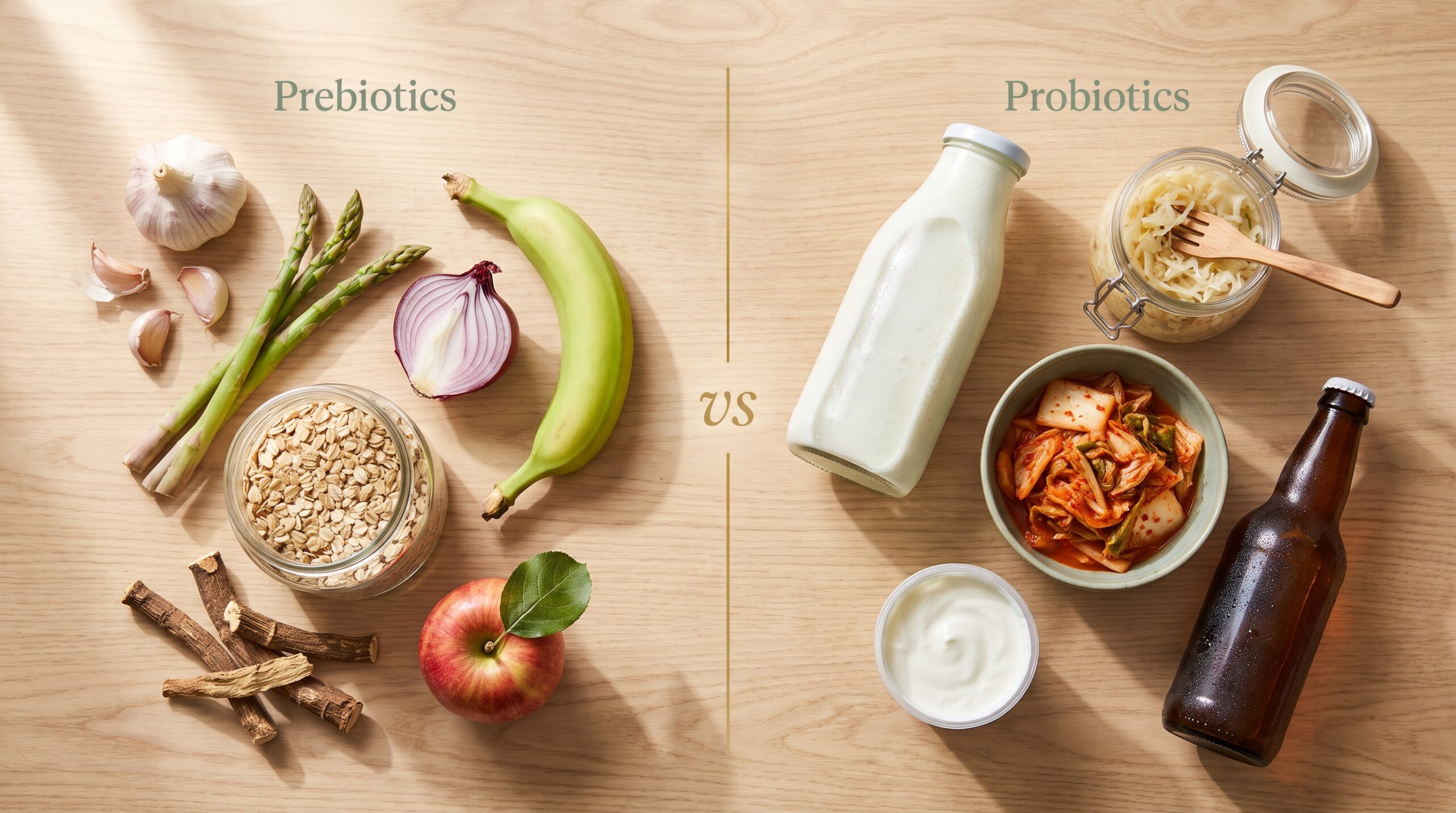
| Primary source | Plant foods (garlic, oats, bananas, onions) | Fermented foods and supplements |
| What they do | Feed and sustain existing beneficial bacteria | Introduce new beneficial bacteria |
| Speed of effect | Gradual — over weeks of consistent intake | Faster — 2 to 4 weeks |
| Who needs them | Almost everyone — most people are deficient | People with dysbiosis, post-antibiotics |
| Can you take both | Yes — synergistic when combined | Yes — synergistic when combined |
| Evidence strength | ⭐⭐⭐⭐⭐ | ⭐⭐⭐⭐⭐ |
The Simplest Way to Understand the Difference

Before the science, here’s the clearest analogy in gut health education.
Think of your gut microbiome as a garden.
Probiotics are the seeds. You plant them — introduce new beneficial bacteria — and hope they establish themselves in the soil. Whether they grow and thrive depends almost entirely on the quality of the soil they land in.
Prebiotics are the fertilizer. They don’t introduce anything new. They feed and strengthen what’s already there — the existing beneficial bacteria that your gut depends on for digestion, immunity, neurotransmitter production, and dozens of other functions.
Both matter. But most people focus exclusively on adding seeds (probiotics) while neglecting the fertilizer (prebiotics) that determines whether those seeds — and the existing garden — can actually flourish.
The research reflects this. A 2021 Stanford study published in Cell found that dietary fiber — the primary source of prebiotic compounds — was essential for sustaining the microbiome diversity gains produced by fermented food consumption. Without adequate prebiotic fiber, even consistent probiotic intake produces limited long-term microbiome improvement.
What Prebiotics Actually Are
The term “prebiotic” was formally defined in 1995 by researchers Gibson and Roberfroid as a non-digestible food ingredient that selectively stimulates the growth and activity of beneficial bacteria in the colon. The definition has since been refined to emphasize selectivity — a true prebiotic specifically feeds beneficial bacteria rather than all bacteria indiscriminately.
Most prebiotics are specific types of dietary fiber — but not all dietary fiber qualifies as prebiotic. What distinguishes prebiotic fiber is three specific characteristics: it resists digestion in the small intestine and arrives intact in the colon, it is fermented by gut bacteria, and it selectively stimulates the growth or activity of beneficial bacterial populations (particularly Lactobacillus and Bifidobacterium species).
The main types of prebiotic fiber
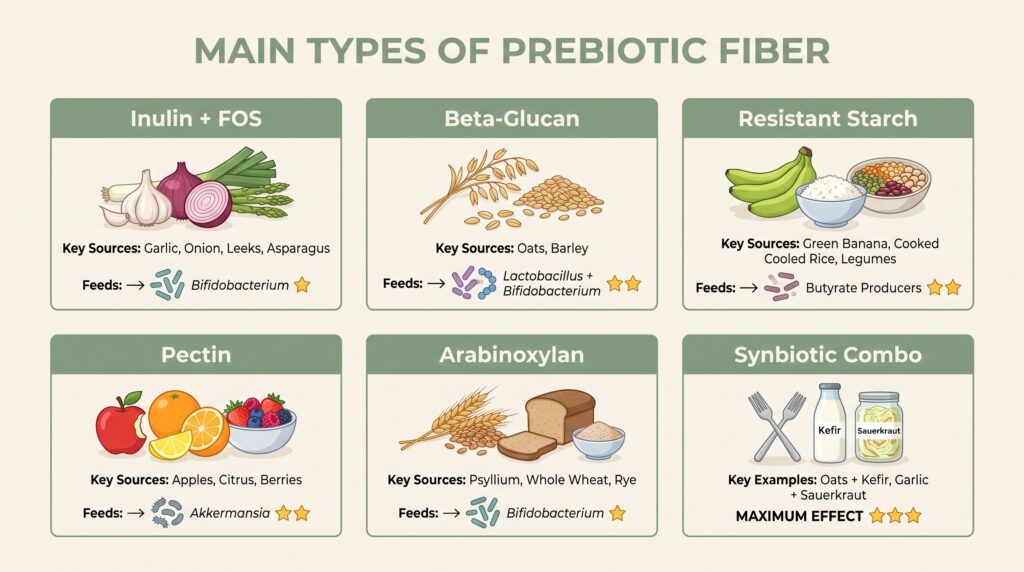
Inulin and fructooligosaccharides (FOS) are the most extensively studied prebiotic compounds. Found in garlic, onions, leeks, asparagus, and chicory root — they specifically and potently stimulate Bifidobacterium growth. Research consistently shows that regular inulin/FOS consumption increases Bifidobacterium populations within two weeks of daily intake.
Beta-glucan is found predominantly in oats and barley. It selectively increases Lactobacillus and Bifidobacterium populations and has specific clinical evidence for reducing inflammatory markers alongside its prebiotic effects. Among the most well-studied prebiotic fibers with consistent human trial evidence.
Resistant starch is found in green (unripe) bananas, cooked and cooled rice, cooked and cooled potatoes, and legumes. Resistant starch is the primary fuel for butyrate-producing bacteria — the bacterial group that produces the short-chain fatty acid most essential for gut lining integrity, colon cell health, and inflammatory regulation. As bananas ripen, resistant starch converts to simple sugar — the gut health benefit is specifically in less-ripe, firmer varieties.
Pectin is found in apples, citrus peel, berries, and plums. Research has shown that pectin specifically promotes Akkermansia muciniphila — the bacterial species most associated with healthy metabolic function and gut barrier integrity.
Arabinoxylan is found in whole wheat, rye, and psyllium husk. Significant evidence for increasing Bifidobacterium and Lactobacillus populations and producing butyrate — the colon’s primary energy source.
The best food sources of prebiotics
Garlic — one of the richest prebiotic sources available and specifically high in both inulin and FOS. Even one clove daily makes a measurable difference.
Onions and leeks — both high in inulin and FOS, and easy to incorporate into daily cooking as a flavor base.
Asparagus — concentrated source of inulin, with six to eight spears providing a meaningful prebiotic dose.
Green (unripe) bananas — resistant starch content at its highest before ripening. Slice into smoothies, eat with nut butter, or blend into overnight oats.
Oats (steel-cut or rolled) — beta-glucan content supports Bifidobacterium populations with specific clinical trial evidence.
Jerusalem artichokes — the most concentrated food source of inulin available. Introduce gradually as they can temporarily increase gas in people with low microbiome diversity.
Chicory root — primary commercial source of inulin (often added to processed foods labeled “chicory root fiber”). Available as a coffee substitute.
Apples and citrus peel — pectin content supports Akkermansia specifically. Eat with the skin on.
What Probiotics Actually Are
The World Health Organization defines probiotics as live microorganisms that, when administered in adequate amounts, confer a health benefit on the host.
Every word in that definition matters. Live — dead bacteria don’t colonize. Adequate amounts — CFU count and survivability determine whether enough bacteria reach the colon intact to produce effects. Confer a health benefit — the benefit must be specific and documented, not assumed.
Probiotics work through several mechanisms once they reach the large intestine: they compete with harmful bacteria for colonization sites and nutrients, produce bacteriocins (natural antimicrobial compounds) that selectively inhibit pathogenic strains, contribute to short-chain fatty acid production that fuels gut lining cells, modulate immune responses in gut-associated lymphoid tissue, and influence neurotransmitter production through the gut-brain axis.
The main categories of probiotic strains
Lactobacillus species are the most widely studied probiotic genus. Found in most fermented dairy products and many supplements. Key strains include L. rhamnosus GG (most studied probiotic strain in the world — evidence for IBS, eczema, antibiotic-associated diarrhea), L. acidophilus (specific evidence for bloating reduction and vaginal health), L. plantarum (evidence for bloating, IBS symptom reduction, and gut barrier support), and L. casei (evidence for digestive regularity and immune function).
Bifidobacterium species predominate in the large intestine and are particularly important for immune function and reducing gut inflammation. Key strains include B. longum (evidence for stress-related gut symptoms and eczema), B. infantis 35624 (specific clinical evidence for IBS bloating and pain), and B. lactis (evidence for immune function and bowel regularity).
Saccharomyces boulardii is a probiotic yeast — the only non-bacterial probiotic with strong clinical evidence. Its unique value: because it’s a yeast rather than bacteria, it survives antibiotic treatment that kills bacterial probiotics. Specific evidence for antibiotic-associated diarrhea and traveler’s diarrhea.
The best food sources of probiotics
Kefir — the most probiotic-rich food available, with 12 or more bacterial strains and significant yeast populations. One cup daily provides more microbial diversity than most probiotic supplements.
Sauerkraut (unpasteurized, refrigerated) — Lactobacillus-dominant, at concentrations of 1.5 million to 10 billion CFU per gram. Only refrigerated, unpasteurized versions contain live bacteria.
Kimchi — synbiotic food providing both probiotics and prebiotic fiber simultaneously.
Plain yogurt with live cultures — look for “contains live and active cultures” explicitly on the label.
Kombucha (raw, unpasteurized) — moderate probiotic content plus beneficial organic acids.
Miso and tempeh — fermented soy products providing beneficial bacteria and enzymes.
For a deep dive on fermented foods and how to use them, read: Fermented Foods for Gut Health: 10 Options to Add to Your Diet
Why You Need Both — The Synbiotic Effect
Here’s the insight that changes how most people approach gut health supplementation.
Taking probiotics without adequate prebiotic fiber is like planting seeds in infertile soil. The seeds may sprout briefly, but without the nutrients they need to establish root systems, they die off quickly. Most probiotic bacteria are transient — they pass through the gut within days to weeks unless the dietary environment actively supports their survival.
Taking prebiotic fiber without any probiotic input feeds whatever bacteria are already present — beneficial and harmful alike. If your microbiome is already significantly dysbiotic, large prebiotic doses without probiotic support can temporarily worsen symptoms by feeding whatever is dominating your gut, including harmful species.
The combination of prebiotics and probiotics — called a synbiotic — produces effects greater than either alone. This is one of the most consistent findings in microbiome intervention research.
A 2020 randomized controlled trial published in Cell Host & Microbe found that a synbiotic intervention (combining specific probiotic strains with their preferred prebiotic substrates) produced significantly greater and more sustained microbiome diversity increases than either probiotics or prebiotics used independently — with parallel improvements in gut barrier function, inflammatory markers, and metabolic health indicators.
The practical implication: when you eat fermented foods (probiotics) alongside garlic-dressed greens, oatmeal with green banana, or any combination of fermented food plus prebiotic fiber, you’re creating a synbiotic effect — and your gut benefits significantly more than from either element consumed in isolation.
Who Needs Probiotics vs Prebiotics vs Both
You primarily need probiotics if: Your gut has been disrupted by a specific event — antibiotics, illness, food poisoning, a period of very poor diet, or significant travel-related digestive disruption. These situations deplete existing beneficial populations and require replenishment. Probiotics address dysbiosis directly by introducing the strains that were lost.
You primarily need prebiotics if: Your overall diet is relatively healthy but low in plant diversity and fiber. Most Americans consume dramatically less prebiotic fiber than optimal — the average American eats 10 to 15 grams of total fiber daily, while recommendations for gut health optimization range from 25 to 38 grams. Increasing prebiotic fiber feeds the beneficial bacteria already present and progressively increases their populations without needing to introduce new strains.
You need both if: You have chronic gut symptoms — persistent bloating, irregular bowel movements, food intolerances, or gut-related symptoms that extend to skin, mood, or immunity. Chronic dysbiosis typically involves both depleted beneficial populations (addressed by probiotics) and an insufficient dietary environment to sustain those populations (addressed by prebiotics). Addressing only one consistently produces incomplete results in this scenario.
If you’re unsure whether your gut needs attention, read: 10 Signs You Have an Unhealthy Gut (And How to Fix It)
How to Use Prebiotics and Probiotics Together
The daily synbiotic routine
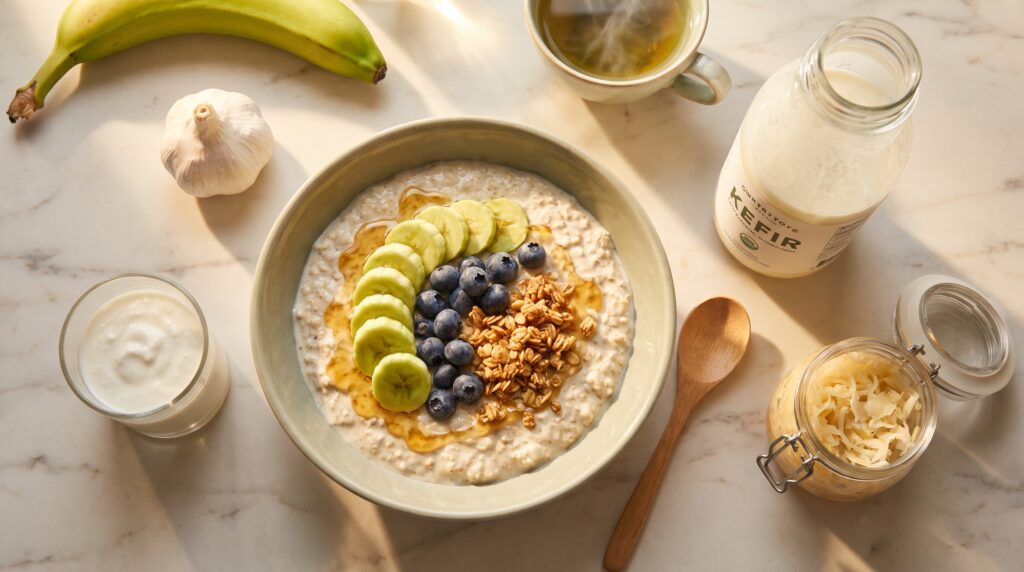
Morning: Overnight oats made with kefir instead of milk (probiotic), topped with sliced green banana (resistant starch prebiotic) and blueberries (pectin prebiotic). This single breakfast creates a powerful synbiotic effect — probiotics and multiple prebiotic substrates consumed simultaneously.
Lunch: A salad built on dark leafy greens, dressed with olive oil and raw garlic (inulin prebiotic), with a side of two to three tablespoons of sauerkraut (probiotic). Again — synbiotic combination with minimal effort.
Dinner: Your main protein with asparagus or leeks roasted in olive oil (inulin prebiotic) and a small side of kimchi (probiotic + prebiotic simultaneously, since kimchi contains both live bacteria and prebiotic vegetable fiber).
This routine naturally creates synbiotic pairings at every meal without requiring separate timing or supplementation planning.
Supplement strategy
If using a probiotic supplement, take it with your largest meal of the day — this is when stomach acid production is highest during and immediately after the meal, and when the food matrix provides some protection for bacteria in transit. The combination of food-based prebiotics at the same meal and a quality probiotic supplement produces the most reliable microbiome support.
💊 Editor’s Pick: Will Silva’s top probiotic recommendation on Amazon (affiliate link — independently researched)
If adding a prebiotic supplement — inulin powder, psyllium husk, or resistant starch — introduce it gradually, starting with half the recommended dose for the first week. Prebiotic supplements can cause significant temporary gas in people whose microbiome is adapting to increased fermentable fiber. This normalizes within one to two weeks for most people.
Common Mistakes With Prebiotics and Probiotics
Taking probiotics without changing diet. A probiotic supplement taken alongside a diet of 80% ultra-processed food produces minimal sustained benefit — the dietary environment actively undermines the bacterial populations the supplement is trying to establish.
Eating too little prebiotic fiber. Most people dramatically underestimate how much prebiotic fiber they consume. Tracking for one week typically reveals that actual intake is a fraction of what gut health optimization requires. Intentionally including at least one prebiotic food source at every meal closes the gap more reliably than relying on incidental consumption.
Expecting immediate results from prebiotics. Prebiotic fiber works gradually — feeding existing bacteria and slowly shifting population balance over weeks and months. It doesn’t produce the relatively faster symptomatic relief that probiotics can deliver. Understanding this prevents premature abandonment.
Choosing the wrong probiotic strains. Generic “Lactobacillus acidophilus” claims aren’t enough. The specific strain designation (the letter-number code after the species name) indicates whether a strain has clinical evidence for the specific benefit you’re targeting. A probiotic with ten strains, none of which have evidence for your specific concern, may outperform a single-strain product in terms of diversity while underperforming it for targeted symptom relief.
Refrigerating shelf-stable probiotics (or not refrigerating ones that need it). Some probiotic strains are shelf-stable and don’t benefit from refrigeration. Others — particularly some Lactobacillus species — have significantly better survivability when kept cold. Check the specific product instructions rather than assuming one approach applies universally.
The Bottom Line
Prebiotics and probiotics aren’t competing products. They’re complementary inputs into the same ecosystem — one introducing beneficial bacteria, the other feeding them.
Most people who take probiotics consistently but don’t see the results they expect are eating insufficient prebiotic fiber — they’re planting seeds in infertile soil. Most people who eat relatively healthily but wonder why their gut health isn’t improving are likely consuming adequate total fiber but insufficient specifically prebiotic fiber, and haven’t addressed the dysbiosis that a targeted probiotic could resolve.
The most powerful approach combines both: daily fermented foods and targeted probiotic supplementation when needed, alongside consistent prebiotic fiber from a diverse range of plant foods.
Feed the garden. Plant good seeds. Give both time to work.
→ Read next: Best Supplements for Gut Health in 2026: What Really Works
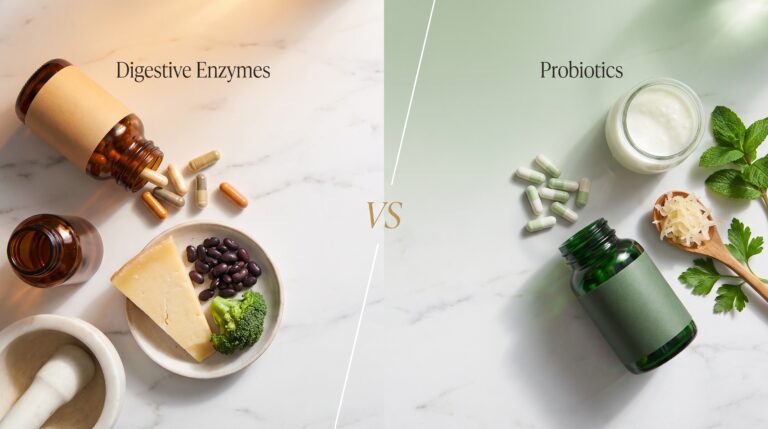
→ Also read: Digestive Enzymes vs Probiotics: Which One Do You Actually Need?
Frequently Asked Questions
Q: Should I take prebiotics and probiotics at the same time? A: Yes — taking them together (creating a synbiotic effect) consistently produces better results than taking either separately. Eating fermented foods alongside prebiotic-rich foods is the most natural and effective way to achieve this. If using supplements, taking your probiotic with a prebiotic-fiber-rich meal maximizes the synergistic effect.
Q: Can you get enough prebiotics from food alone? A: Yes, if you eat a diverse, plant-rich diet with consistent inclusion of garlic, onions, oats, asparagus, green bananas, and legumes. Most Americans don’t, which is why prebiotic supplements (inulin powder, psyllium husk, resistant starch) are useful additions for people who find consistent dietary prebiotic intake difficult.
Q: Do prebiotics cause bloating? A: They can, temporarily — particularly when introduced quickly in large amounts to a gut with low microbial diversity. The bacteria fermenting the prebiotic fiber produce gas as a byproduct. This typically resolves within one to two weeks as the microbiome adapts. Starting with small amounts and increasing gradually prevents most of the discomfort.
Q: Are prebiotic supplements as effective as prebiotic foods? A: Prebiotic supplements provide isolated prebiotic compounds (typically inulin or FOS) without the additional nutrients, polyphenols, and fiber diversity that whole prebiotic foods provide. They’re useful for supplementing a diet that’s already reasonable but falls short of optimal prebiotic intake. Whole prebiotic foods are preferable when practical.
Q: How long do I need to take probiotics? A: It depends on the reason. For post-antibiotic recovery, four to eight weeks of consistent probiotic supplementation combined with dietary support is typically sufficient. For chronic dysbiosis or ongoing gut conditions, longer-term supplementation — often with periodic assessment — is more appropriate. Daily fermented food consumption can eventually reduce or replace the need for supplemental probiotics for many people.
References & Further Reading
- Gibson GR & Roberfroid MB. “Dietary modulation of the human colonic microbiota: introducing the concept of prebiotics.” Journal of Nutrition, 1995.
- Wastyk HC, et al. “Gut-microbiota-targeted diets modulate human immune status.” Cell, 2021.
- Swanson KS, et al. “The International Scientific Association for Probiotics and Prebiotics (ISAPP) consensus statement on the definition and scope of synbiotics.” Nature Reviews Gastroenterology & Hepatology, 2020.
- Dahl WJ & Stewart ML. “Position of the Academy of Nutrition and Dietetics: Health Implications of Dietary Fiber.” Journal of the Academy of Nutrition and Dietetics, 2015.
- Hill C, et al. “Expert consensus document: The International Scientific Association for Probiotics and Prebiotics consensus statement on the scope and appropriate use of the term probiotic.” Nature Reviews Microbiology, 2014.
This article is for informational purposes only and does not constitute medical advice. Always consult a qualified healthcare professional for personal health concerns.