Gut Health and Weight Loss: The Surprising Connection
Nobody talks about the gut-weight connection the way they should.
Weight loss conversations in America are almost entirely focused on two variables: calories and exercise. Eat less, move more. The formula is simple, the advice is everywhere, and for millions of people it genuinely doesn’t work — not because they lack discipline, but because the conversation is missing a third variable that the research is increasingly impossible to ignore.
Your gut microbiome.
The trillions of microorganisms living in your digestive tract don’t just process food. They regulate how efficiently your body extracts energy from that food, how your fat storage hormones respond to what you eat, how your appetite signals function, and how inflamed your metabolic environment is. Two people can eat identical meals and have meaningfully different metabolic outcomes — and a significant part of that difference comes down to what’s living in their gut.
This isn’t a fringe idea. It’s one of the most actively researched areas in obesity science right now. And understanding it changes not just how you think about weight loss, but what you actually do about it.
Quick Reference: Gut Health and Weight Loss Connection
| Factor | How Gut Affects It | Research Strength |
|---|---|---|
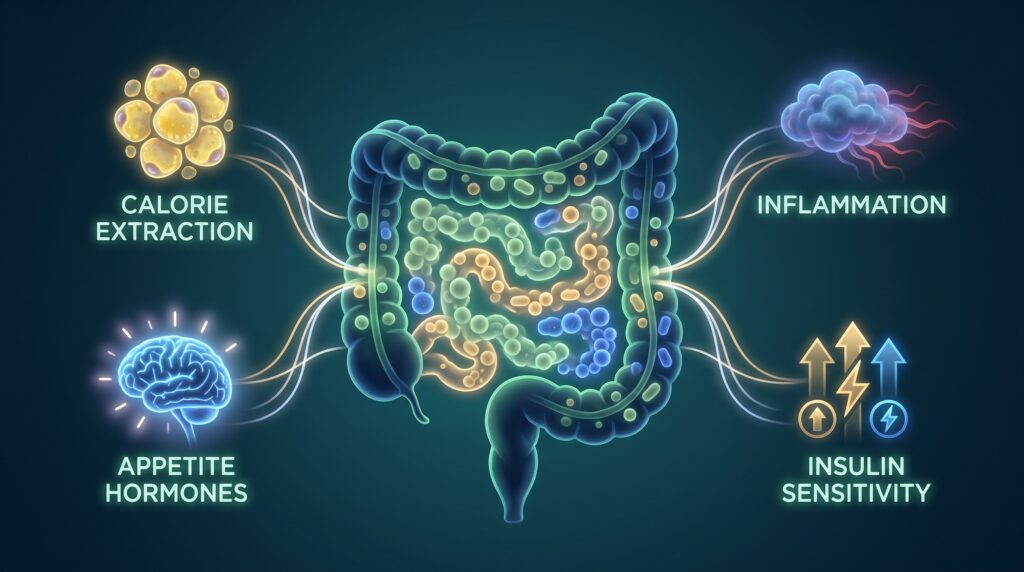
| Calorie extraction | Firmicutes bacteria extract more calories from same food | ⭐⭐⭐⭐⭐ |
| Appetite hormones | Gut bacteria regulate ghrelin and leptin signaling | ⭐⭐⭐⭐⭐ |
| Inflammation | Dysbiosis drives chronic inflammation that impairs fat loss | ⭐⭐⭐⭐⭐ |
| Insulin sensitivity | Microbiome composition affects glucose metabolism | ⭐⭐⭐⭐ |
| Fat storage | Short-chain fatty acids regulate adipogenesis | ⭐⭐⭐⭐ |
| Food cravings | Gut bacteria influence neurotransmitter-driven cravings | ⭐⭐⭐⭐ |
| Sleep quality | Microbiome disruption impairs sleep, slows metabolism | ⭐⭐⭐⭐ |
The Science Behind the Gut-Weight Connection
Let’s start with the experiment that changed how researchers think about obesity.
In 2013, a team at Washington University in St. Louis published a landmark study in Science. They took gut bacteria from pairs of human twins — one obese, one lean — and transplanted them into germ-free mice that had no gut bacteria of their own. The mice that received bacteria from the obese twin gained significantly more body fat than those that received bacteria from the lean twin — despite eating the same diet.
The bacteria alone drove the weight difference. Not genetics. Not calories. Not willpower. The composition of the gut microbiome determined how much fat the mice stored.
This wasn’t a fluke. The finding has been replicated, extended, and refined across hundreds of subsequent studies. The picture that has emerged is one of the most significant paradigm shifts in obesity research of the past 20 years: the gut microbiome is not a passive observer of metabolism. It is an active regulator of it.
If you’ve noticed signs of broader gut imbalance beyond just weight issues, read: 10 Signs You Have an Unhealthy Gut (And How to Fix It)
6 Ways Your Gut Microbiome Affects Your Weight
1. It Determines How Many Calories You Extract From Food
The most direct mechanism — and the one that challenges the most fundamental assumption of calorie counting.
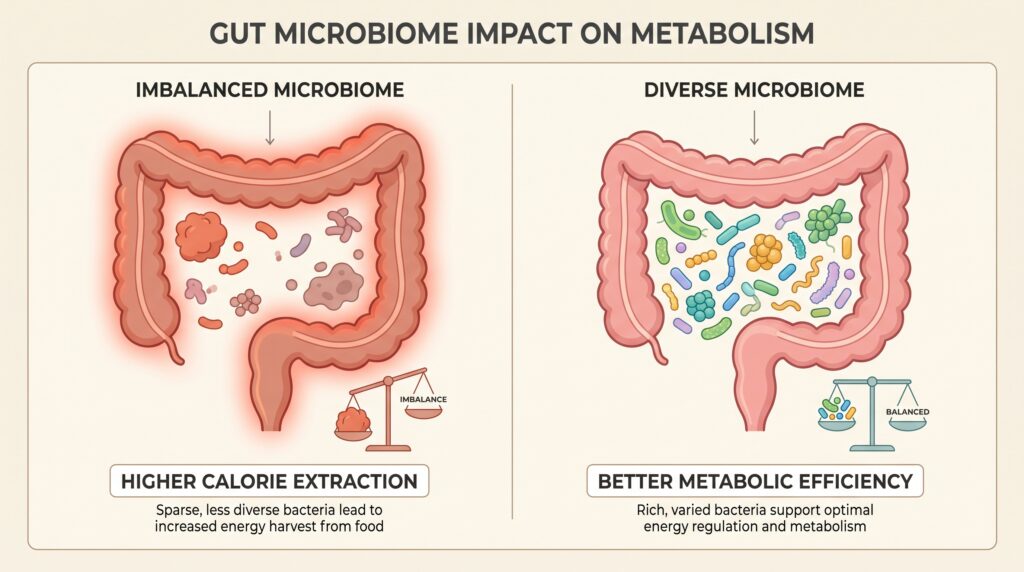
Your gut bacteria ferment dietary fiber and other complex carbohydrates that your own digestive enzymes cannot break down. In the process, they extract additional calories from those foods and produce short-chain fatty acids (SCFAs) like butyrate, propionate, and acetate.
The efficiency of this fermentation process varies significantly depending on which bacteria are present. Research has consistently shown that people with higher proportions of Firmicutes bacteria relative to Bacteroidetes — a ratio consistently found in people with obesity — extract significantly more calories from the same quantity of food than those with the inverse ratio.
A 2019 study in Cell Host & Microbe estimated that differences in gut microbiome composition could account for caloric absorption differences of 150–200 calories per day between individuals eating identical diets. Over a year, that difference alone represents 15–20 pounds of potential weight variation from gut bacteria alone — before diet or exercise are even considered.
In other words: calorie labels are averages. What you actually absorb from food is partly determined by what’s living in your gut.
2. It Regulates Your Hunger and Satiety Hormones
Your gut is the largest endocrine organ in your body. It produces and regulates a range of hormones that directly control appetite — and the composition of your gut microbiome significantly influences how those hormones function.
The two most relevant are ghrelin and GLP-1.
Ghrelin is your primary hunger hormone — produced mainly in the stomach, it signals your brain that it’s time to eat. Research has shown that gut dysbiosis is associated with elevated fasting ghrelin levels, meaning a disrupted microbiome keeps you feeling hungrier more of the time than a balanced one would.
GLP-1 (glucagon-like peptide-1) is a satiety hormone produced in the gut lining in response to food. It signals fullness to the brain, slows gastric emptying, and reduces appetite. Specific gut bacteria — particularly Akkermansia muciniphila and Bifidobacterium species — stimulate GLP-1 production. When these bacteria are depleted, GLP-1 signaling weakens, and the feeling of fullness after eating is blunted.
This hormonal disruption creates a physiological disadvantage for weight management that has nothing to do with willpower. You’re genuinely hungrier and less satisfied after eating — not because you lack self-control, but because your gut bacteria aren’t producing the hormonal signals that make restraint feel manageable.
3. It Drives the Chronic Inflammation That Blocks Fat Loss
This mechanism is perhaps the least understood by the general public — and potentially the most impactful.
When gut dysbiosis leads to increased intestinal permeability (leaky gut), bacterial fragments called lipopolysaccharides (LPS) from gram-negative bacteria enter the bloodstream. The immune system responds to these fragments as foreign invaders, triggering a systemic inflammatory response.
Chronic low-grade inflammation, driven by this constant LPS exposure, directly impairs fat metabolism in several ways. It disrupts insulin signaling, promoting insulin resistance that directs glucose toward fat storage rather than energy production. It activates inflammatory pathways in adipose tissue that promote fat cell proliferation. It raises cortisol levels, which independently drives fat storage — particularly in the abdominal region.
A 2017 meta-analysis in Obesity Reviews found that markers of gut-derived inflammation (particularly LPS and intestinal permeability markers) were significantly elevated in people with obesity compared to lean controls — and that interventions reducing gut inflammation consistently produced improvements in metabolic markers independent of changes in diet or exercise.
Healing the gut lining directly reduces this inflammatory burden. Read: What Is Leaky Gut Syndrome? Symptoms, Causes and How to Heal
4. It Influences Insulin Sensitivity and Blood Sugar Regulation
Insulin resistance — the condition in which cells become less responsive to insulin’s signal to absorb glucose — is both a driver and a consequence of weight gain. The gut microbiome plays a direct role in its development and severity.
Short-chain fatty acids produced by beneficial gut bacteria, particularly propionate and butyrate, directly improve insulin sensitivity through multiple pathways: they activate specific receptors in gut cells that regulate glucose uptake, they reduce hepatic glucose production, and they support the function of pancreatic beta cells that produce insulin.
A 2018 study published in Nature Medicine found that transplanting gut microbiota from metabolically healthy donors to people with metabolic syndrome improved insulin sensitivity in recipients within 6 weeks — with no changes in diet. The microbiome transplant alone improved the recipients’ glucose metabolism measurably.
Conversely, dysbiosis — particularly overgrowth of bacteria that produce secondary bile acids and other metabolites that impair insulin signaling — is independently associated with worse insulin resistance, higher fasting glucose, and greater abdominal fat accumulation.
5. It Controls Cravings for the Foods That Promote Weight Gain
This mechanism is one that most people find both surprising and instantly recognizable once they understand it.
Certain gut bacteria — particularly Candida albicans and some pathogenic bacterial strains — produce metabolic byproducts that cross the blood-brain barrier and mimic the chemical signals associated with hunger and craving. Specifically, they appear to stimulate dopamine pathways associated with reward-seeking behavior, creating cravings for the high-sugar, high-fat foods that feed those same bacteria.
It’s a self-reinforcing cycle: dysbiotic bacteria drive cravings for processed food, which feeds more dysbiotic bacteria, which drives more cravings. The person in this cycle experiences what feels like lack of willpower — but the underlying driver is microbial, not psychological.
Research published in BioEssays in 2014 proposed that gut microorganisms actively manipulate host eating behavior to promote their own fitness — by producing neuroactive compounds that influence food preferences and satiety signals. The implications for understanding dietary behavior and obesity are profound.
Shifting your gut microbiome toward more beneficial bacterial populations — through the dietary interventions that have the strongest evidence — reduces these bacterially-driven cravings over 4–8 weeks, often before any significant weight loss has occurred.
6. It Affects Sleep Quality, Which Directly Impacts Weight
The gut-weight connection runs through sleep in ways that most weight loss programs never address.
Your gut microbiome follows a circadian rhythm. It regulates serotonin production (which converts to melatonin) and influences the sleep-wake cycle through the gut-brain axis. When the microbiome is disrupted, sleep architecture is disrupted — with measurable reductions in deep sleep duration and sleep efficiency.
Poor sleep, in turn, creates the hormonal conditions that drive weight gain: elevated cortisol, increased ghrelin, suppressed leptin, reduced insulin sensitivity, and impaired glucose metabolism. A single night of sleep deprivation produces measurable changes in appetite-regulating hormones that reliably increase caloric intake the following day.
The cascade runs both directions: gut dysbiosis disrupts sleep, and disrupted sleep worsens gut dysbiosis. Breaking this cycle requires addressing both simultaneously — not treating them as separate problems.
What to Do About It — The Gut-Weight Connection in Practice
Understanding the mechanism is step one. Here’s what the evidence supports for actually leveraging the gut-weight connection.
Increase microbial diversity through plant variety
The single most impactful dietary change for weight-relevant gut health is increasing the diversity of plants you eat. The American Gut Project found that people eating 30 or more different plant foods per week had significantly higher microbial diversity — and higher diversity is consistently associated with healthier weight and better metabolic markers.
This doesn’t mean eating more — it means eating more different things. Rotating vegetables, grains, legumes, nuts, seeds, and herbs across the week progressively feeds a wider range of beneficial bacteria that compete with the dysbiotic species driving inflammation and appetite disruption.
For a complete framework for building plant diversity into your daily eating, read: Gut Health Diet Plan for Beginners: A Complete 7-Day Guide
Add fermented foods daily
The Stanford Cell study remains the most compelling evidence: a high-fermented-food diet significantly reduces 19 inflammatory markers within 10 weeks — including markers directly associated with impaired fat metabolism and insulin resistance. Kefir, sauerkraut, kimchi, and plain yogurt with live cultures are the most accessible and evidence-backed options.
Combining fermented foods with prebiotic fiber produces a synbiotic effect — introducing beneficial bacteria and simultaneously feeding them — that research shows produces more significant microbiome shifts than either approach alone.
Specifically target Akkermansia muciniphila
This bacterial species deserves special mention in the gut-weight context. Akkermansia muciniphila is consistently depleted in people with obesity and metabolic syndrome, and its restoration is associated with improved gut barrier function, reduced inflammation, improved insulin sensitivity, and reduced fat mass.
Akkermansia thrives on mucin (the gut’s protective mucus layer) and polyphenols. Foods that specifically promote Akkermansia growth include pomegranate, cranberry, grape skin, green tea, and dark chocolate — all high in polyphenols. Reducing ultra-processed food consumption is also critical, as emulsifiers directly deplete Akkermansia populations.
Reduce ultra-processed food — for microbiome reasons, not just calorie reasons
Most people understand that ultra-processed food contributes to weight gain through caloric density. What’s less understood is that it simultaneously damages the gut microbiome in ways that independently promote weight gain — by disrupting the bacterial balance that regulates appetite hormones, creating the inflammatory environment that impairs insulin sensitivity, and depleting the Akkermansia and Bifidobacterium populations that support healthy weight.
Reducing ultra-processed food addresses both mechanisms simultaneously. It’s not just about calories — it’s about removing the inputs that actively destabilize the gut ecosystem driving metabolic dysfunction.
Consider targeted supplementation
A quality multi-strain probiotic, combined with dietary changes, has evidence for improving the Firmicutes/Bacteroidetes ratio and supporting the appetite-regulating bacteria depleted in dysbiosis. L-glutamine supports gut lining repair, reducing the LPS-driven inflammation that impairs fat metabolism. Omega-3 fatty acids reduce gut inflammation and have demonstrated specific effects on Akkermansia populations.
💊 Editor’s Pick: Will Silva’s top probiotic recommendation on Amazon (affiliate link — independently researched)
For the complete supplement guide, read: Best Supplements for Gut Health in 2026: What Really Works
What to Expect — Realistic Timeline
The gut-weight connection produces results on a different timeline than conventional calorie restriction — and understanding that timeline prevents the frustration that causes people to abandon the approach prematurely.
Weeks 1–4: Microbiome begins to shift. Inflammation markers start to reduce. Many people notice reduced bloating, more stable energy, and — critically — reduced cravings for processed food. Scale weight may not change significantly in this window.
Weeks 4–8: Appetite hormone regulation begins to normalize. Hunger becomes more manageable. Food satisfaction improves. Some people begin losing weight in this window, particularly abdominal fat.
Months 2–4: Insulin sensitivity improves measurably. The metabolic environment that was promoting fat storage begins to shift. Weight loss, when it comes through this mechanism, tends to be gradual — 1–2 pounds per week — but sustainable, because it reflects genuine metabolic improvement rather than temporary caloric restriction.
Beyond 4 months: The changes in this window are cumulative. A more diverse, balanced microbiome requires less active maintenance — the dietary habits that produced the shift become self-reinforcing as the microbiome itself begins producing the hormonal signals that support continued healthy choices.
The Bottom Line
The gut-weight connection is not a marketing concept. It is a documented, mechanistically understood, and increasingly well-replicated area of obesity science that challenges the oversimplified calorie-in-calorie-out model that has dominated weight loss conversations for decades.
Your gut bacteria determine how many calories you extract from food. They regulate the hormones that control your hunger and fullness. They drive or reduce the chronic inflammation that impairs your ability to lose fat. They influence the cravings that make dietary change feel impossible. They affect the sleep quality that governs your metabolic hormones overnight.
Addressing the gut microbiome doesn’t replace attention to diet quality and physical activity. It creates the biological conditions in which those efforts actually work — for the first time, for many people who have been doing everything “right” without results.
Start with the microbiome. Everything else becomes easier from there.
→ Read next: Digestive Enzymes vs Probiotics: Which One Do You Actually Need?
→ Also read: How to Improve Your Gut Microbiome Naturally (7 Proven Ways)
Frequently Asked Questions
Q: Can healing your gut actually help you lose weight? A: The research says yes — through multiple documented mechanisms including improved calorie extraction efficiency, better appetite hormone regulation, reduced chronic inflammation, and improved insulin sensitivity. Weight loss through gut health interventions tends to be gradual but sustainable, and is often accompanied by broader metabolic improvements.
Q: How long does it take to see weight changes from gut health improvements? A: Most people notice reduced cravings and improved appetite regulation within 4–8 weeks of consistent dietary changes targeting the gut microbiome. Meaningful, sustained weight changes typically develop over 2–4 months — faster when gut health improvements are combined with overall dietary quality improvements.
Q: What gut bacteria are most associated with healthy weight? A: Akkermansia muciniphila, Bifidobacterium species, and butyrate-producing bacteria like Faecalibacterium prausnitzii are most consistently associated with lean body composition and healthy metabolic markers. Higher overall microbial diversity is also independently associated with healthier weight across multiple large studies.
Q: Is the Firmicutes/Bacteroidetes ratio really that important for weight? A: It’s one significant factor among several. The original research showing higher Firmicutes/Bacteroidetes ratios in obesity has been replicated but also nuanced — specific species within those phyla matter more than the ratio alone. Current research focuses more on microbial diversity and specific beneficial species than on this single ratio.
Q: Does gut health affect belly fat specifically? A: Yes — abdominal (visceral) fat is particularly associated with gut-derived inflammation. LPS from leaky gut activates inflammatory pathways that specifically promote visceral fat accumulation and impair its mobilization. Interventions reducing gut inflammation consistently show disproportionate effects on abdominal fat compared to subcutaneous fat.
References & Further Reading
- Ridaura VK, et al. “Gut microbiota from twins discordant for obesity modulate metabolism in mice.” Science, 2013.
- Turnbaugh PJ, et al. “A core gut microbiome in obese and lean twins.” Nature, 2009.
- Koh A, et al. “From dietary fiber to host physiology: short-chain fatty acids as key bacterial metabolites.” Cell, 2016.
- Plovier H, et al. “A purified membrane protein from Akkermansia muciniphila or the pasteurized bacterium improves metabolism in obese and diabetic mice.” Nature Medicine, 2017.
- Cotillard A, et al. “Dietary intervention impact on gut microbial gene richness.” Nature, 2013.
- Kootte RS, et al. “Improvement of Insulin Sensitivity after Lean Donor Feces in Metabolic Syndrome.” Cell Metabolism, 2017.
This article is for informational purposes only and does not constitute medical advice. Always consult a qualified healthcare professional for personal health concerns.


2 Comments