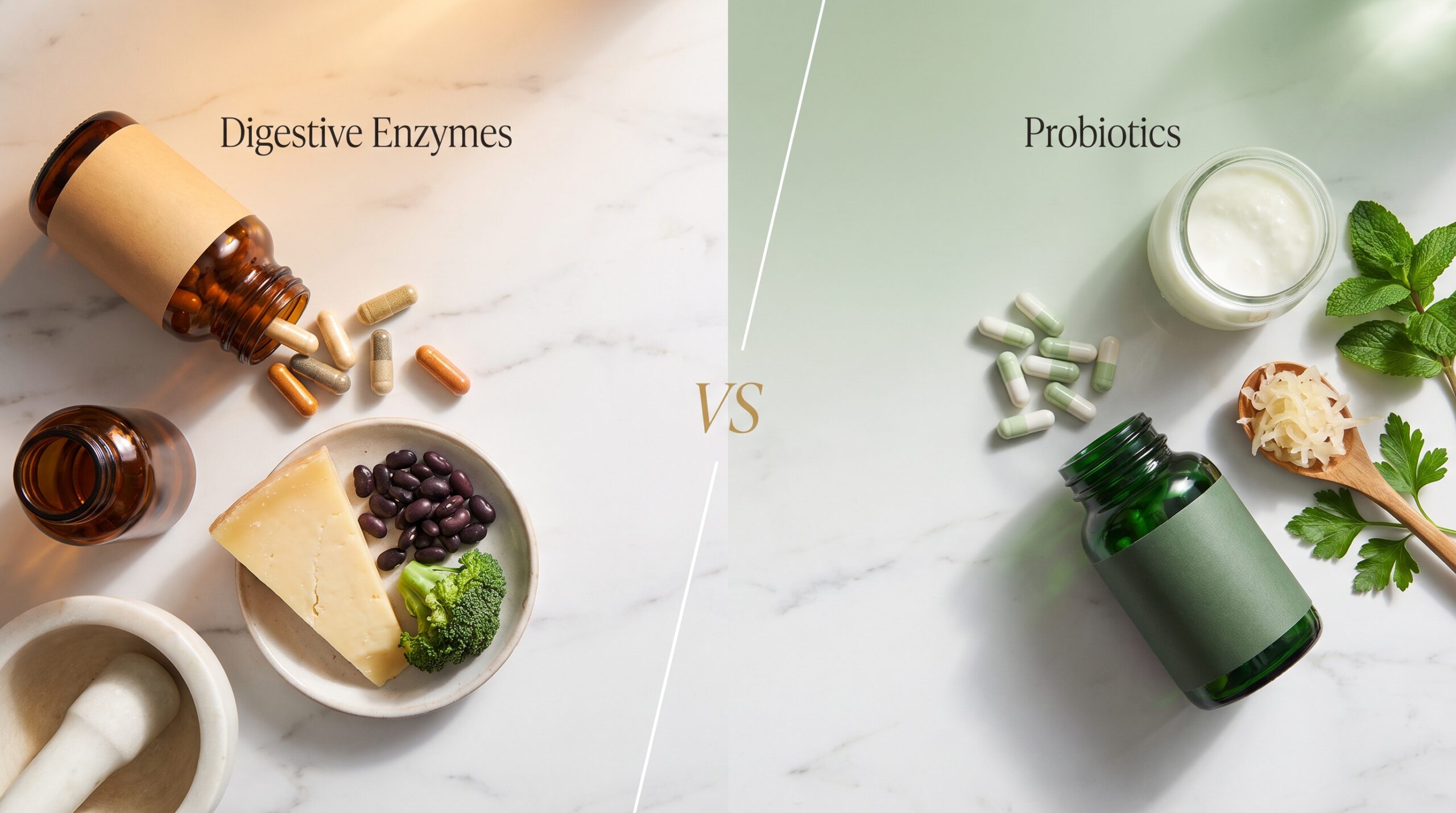
Digestive Enzymes vs Probiotics: Which One Do You Actually Need?

At some point, almost everyone interested in gut health ends up staring at two products in a store aisle — or two tabs open on their phone — trying to figure out which one they actually need.
Digestive enzymes. Probiotics.
Both claim to support digestion. Both are marketed for bloating, gas, and gut discomfort. Both have real clinical evidence. And yet they work through completely different mechanisms, address different root causes, and are appropriate for different people — sometimes at the same time, sometimes not.
The confusion is understandable. Most content on this topic either treats them as interchangeable or recommends both without explaining why. Neither is particularly helpful when you’re trying to make a practical, evidence-based decision about what to actually take.
This article fixes that. By the end, you’ll know exactly which one applies to your situation — or whether you need both — and why.
Quick Reference: Digestive Enzymes vs Probiotics
| Factor | Digestive Enzymes | Probiotics |
|---|---|---|
| What they are | Proteins that break down food | Live beneficial bacteria |
| Where they work | Small intestine (digestion) | Large intestine (microbiome) |
| What they fix | Incomplete food breakdown | Microbial imbalance |
| Speed of results | 3–7 days | 2–4 weeks |
| Best for | Bloating after meals, enzyme deficiency | Dysbiosis, IBS, post-antibiotic recovery |
| Works without diet change | Partially | Poorly |
| Can take together | Yes — complementary | Yes — complementary |
| Evidence strength | ⭐⭐⭐⭐ | ⭐⭐⭐⭐⭐ |
The Fundamental Difference
Everything else in this article follows from understanding one core distinction.
Digestive enzymes are a functional tool. They support a process — the breakdown of food — that your body is supposed to do on its own but may not be doing efficiently enough. They don’t change anything about your gut microbiome. They don’t add beneficial bacteria. They don’t heal your gut lining. They simply make the digestive process work better, more completely, and with less byproduct.
Probiotics are a population-level intervention. They work by introducing beneficial bacteria that compete with harmful bacteria for space, produce compounds that support gut lining integrity, influence neurotransmitter production, and actively reshape the microbial ecosystem of your gut over time. They don’t directly affect how food is broken down in the small intestine. They work downstream — in the large intestine — on the bacterial community that determines how your gut functions at a systemic level.
Understanding which problem you have determines which tool is appropriate.
What Digestive Enzymes Actually Do
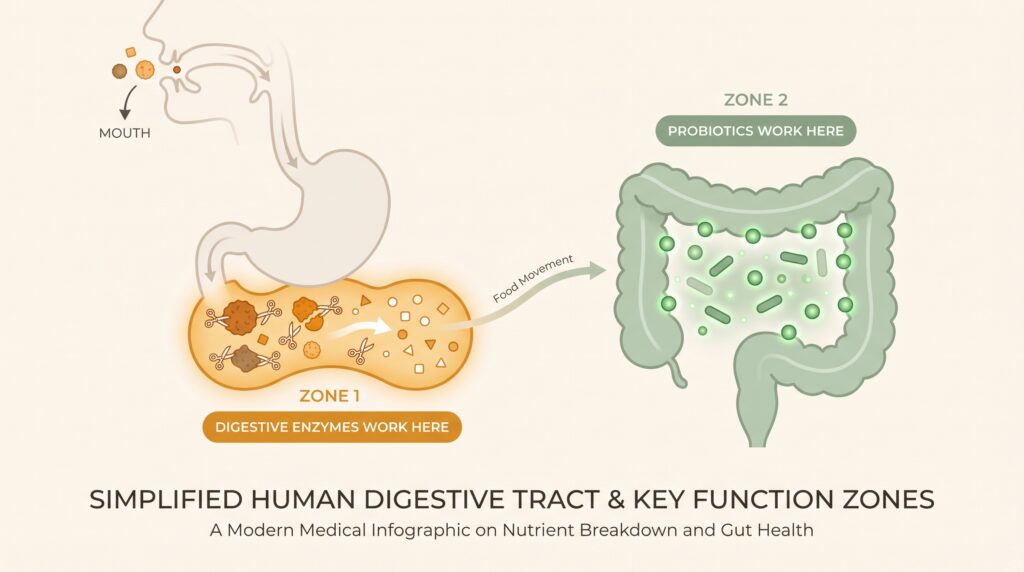
Your digestive system produces several categories of enzymes that break food down into absorbable components.
Amylase (from saliva and the pancreas) breaks down complex carbohydrates into simple sugars. Protease breaks down protein into amino acids. Lipase breaks down fat into fatty acids and glycerol. Lactase breaks down lactose — the sugar in dairy products. Alpha-galactosidase breaks down the complex carbohydrates in legumes and cruciferous vegetables that humans can’t digest on their own.
When production of any of these enzymes is insufficient — whether due to pancreatic insufficiency, low stomach acid, gut inflammation, age-related decline, or simply genetic variation — food arrives in the large intestine partially undigested. Gut bacteria ferment that undigested material, producing hydrogen and methane gas. The result is the bloating, gas, distension, and discomfort that many people attribute to specific food sensitivities.
This is a functional problem with a functional solution: supplying the enzymes the digestive process is lacking.
A 2018 systematic review in the Journal of the International Medical Research found that broad-spectrum digestive enzyme supplementation significantly reduced bloating, flatulence, and post-meal discomfort in adults with functional digestive symptoms — with effects beginning within one week of supplementation.
When digestive enzymes are the right choice:
You bloat quickly after meals — within 30 to 60 minutes — particularly after eating protein-rich foods, dairy, legumes, or cruciferous vegetables. Your bloating is meal-dependent: it starts after eating and resolves between meals. You experience belching, a sensation of food sitting heavily in your stomach, or feel full very quickly after eating small amounts. Your symptoms are worse as you’ve gotten older. You’ve noticed that avoiding specific food categories (dairy, beans, broccoli) completely resolves the issue — suggesting enzyme-specific deficiency rather than general gut dysfunction.
What Probiotics Actually Do
Probiotics work on a completely different timescale and through completely different mechanisms than digestive enzymes.
When you take a quality probiotic, you’re introducing live bacterial strains that travel through the stomach and small intestine to the large intestine, where the majority of your gut microbiome lives. Once there, they compete with existing bacteria for colonization sites, produce bacteriocins that selectively inhibit harmful bacteria, contribute to short-chain fatty acid production that feeds gut lining cells, and gradually shift the overall composition of the microbial community.
This process takes time — which is why probiotics don’t produce the immediate relief that digestive enzymes can deliver. The microbiome doesn’t shift in a day. But the changes probiotics produce, when they occur, are more fundamental and more far-reaching than anything digestive enzymes can achieve.
A 2014 meta-analysis in Alimentary Pharmacology & Therapeutics analyzed 43 randomized controlled trials and found that probiotics significantly reduced overall IBS symptom scores, bloating, and bowel habit irregularity — with effects that continued and deepened over the duration of supplementation, typically 4–12 weeks.
When probiotics are the right choice:
Your bloating is present regardless of what you eat — it’s there even after relatively simple, easy-to-digest meals. Your gut symptoms started after a course of antibiotics. You have irregular bowel movements — constipation, diarrhea, or alternating between both. You have diagnosed IBS. You experience symptoms beyond digestion — mood changes, brain fog, fatigue, skin issues — that suggest systemic gut dysfunction. You’ve been through a period of high stress, poor diet, or illness that seems to have disrupted your gut health in a lasting way. You’ve identified signs of broader gut imbalance: 10 Signs You Have an Unhealthy Gut (And How to Fix It)
The Overlap — and Why Both Are Sometimes the Answer

Here’s where it gets more nuanced — and more practically useful.
In many people with chronic gut issues, both problems exist simultaneously. The microbiome is imbalanced — producing too much gas from bacterial fermentation — and enzyme production is insufficient — sending too much undigested food to those bacteria in the first place.
In that scenario, addressing only one problem produces partial results. The probiotic shifts the bacterial population, but the food still arrives partially undigested. The digestive enzyme improves breakdown efficiency, but the dysbiotic bacteria are still present to ferment whatever residue remains. Addressing both simultaneously produces more significant and faster improvement than either approach alone.
Research published in the World Journal of Gastroenterology found that the combination of digestive enzyme supplementation and probiotic supplementation produced significantly greater reductions in bloating and overall digestive symptoms than either supplement used independently — supporting the additive benefit of concurrent use.
You likely need both if:
Your bloating is present both during and between meals (suggesting both bacterial and enzymatic contributions). Your gut issues have been present for a long time and seem resistant to dietary change alone. You have multiple gut symptoms — bloating plus irregular bowel movements plus food intolerances plus fatigue or mood changes. You’ve already tried one without adequate results.
If you want to understand the full supplement landscape for gut health, read: Best Supplements for Gut Health in 2026: What Really Works
How to Choose the Right Probiotic
Not all probiotics are equivalent. Strain selection matters more than most people realize — and more than most product labels make clear.
For bloating and gas specifically, the strains with the most published clinical evidence include Lactobacillus plantarum (specific evidence for bloating and IBS symptoms), Bifidobacterium infantis 35624 (specific evidence for bloating, pain, and bowel irregularity in IBS), and Lactobacillus acidophilus NCFM (evidence for gas and bloating reduction). Multi-strain formulas consistently outperform single-strain products for general gut health support.
CFU count guaranteed at expiration — not at manufacture — matters. Delivery mechanism matters. Third-party testing matters.
💊 Best Probiotics for Bloating and Gas — detailed review of top 5 options
💊 Will Silva’s top probiotic pick on Amazon (Ad — affiliate link. We only recommend products we’ve researched.)
How to Choose the Right Digestive Enzyme
Digestive enzyme products vary enormously in formulation. Here’s what to look for.
Broad-spectrum coverage is more important than any single enzyme. A formula that includes amylase, protease, and lipase covers all three macronutrients. Adding lactase and alpha-galactosidase addresses the two most common specific enzyme deficiencies (dairy and legumes/vegetables respectively).
Enzyme activity units — not milligrams — are the meaningful measure of potency. Look for amylase measured in DU (dextrinizing units), protease in HUT (hemoglobin units on the tyrosine basis), and lipase in FIP or LU (lipase units). Products that list only milligrams without activity units cannot be meaningfully compared.
Timing is critical. Digestive enzymes must be taken immediately before or at the very beginning of a meal — not after. They need to be present in the stomach as food arrives to catalyze the breakdown process from the start. Taking them after a meal significantly reduces their effectiveness.
Betaine HCl is worth considering for people who suspect low stomach acid specifically. Low stomach acid is a prerequisite for enzyme activation — even adequate enzyme production is impaired if stomach pH is insufficient to activate the enzymes. Betaine HCl supports stomach acid production and is frequently combined with digestive enzymes for this reason.
A Practical Decision Framework
Start here:
When did your symptoms start? If they followed a specific event — antibiotics, illness, travel, a prolonged period of poor eating or high stress — probiotics address the disruption that event caused. If your symptoms have been present your entire life or worsened gradually with age, digestive enzyme deficiency is more likely the primary driver.
What triggers your symptoms? If specific food categories consistently cause problems (dairy, beans, gluten, cruciferous vegetables), enzyme deficiency for those specific substrates is likely. If almost everything causes symptoms regardless of what you eat, dysbiosis — microbiome imbalance — is the more probable root cause.
What does your symptom pattern look like? Bloating that reliably starts 30–90 minutes after eating and resolves before the next meal points toward digestive enzymes. Bloating that’s present most of the time, that varies with stress as much as with food, and that comes with non-digestive symptoms (mood, energy, skin, immunity) points toward probiotics.
How long have you had symptoms? New or recent-onset symptoms following an identifiable trigger respond faster to probiotics. Long-standing, chronic symptoms often involve both problems and benefit from both solutions.
Timeline: What to Expect From Each
Digestive enzymes: Most people notice meaningful improvement in post-meal bloating within 3–7 days. The effect is relatively immediate because enzymes address a functional problem with a functional solution — you’re either providing the enzyme or you’re not, and the gut responds accordingly. If you haven’t noticed any improvement within 2 weeks, either the enzyme formula isn’t covering your specific deficiency or the root cause of your bloating is microbial rather than enzymatic.
Probiotics: Initial adjustment — sometimes including temporary increased gas — typically occurs in the first 7–14 days as the microbiome adapts. Meaningful symptom improvement usually becomes apparent at 3–4 weeks. More significant and sustained improvement develops over 6–12 weeks of consistent use. If you see no benefit at 8 weeks, either the probiotic formula doesn’t contain the strains relevant to your specific gut issue or there’s an underlying condition (like SIBO) that requires more targeted treatment.
If you’re still unclear on your bloating root cause specifically, read: Why Am I Always Bloated? 8 Real Causes and Natural Remedies
What Neither Can Do Alone
It’s worth being explicit about the limitations of both.
Neither digestive enzymes nor probiotics will produce meaningful, lasting results in the absence of a gut-supportive diet. Digestive enzymes can’t compensate for a diet that’s continuously overwhelming your digestive capacity. Probiotics can’t establish a healthy microbiome in an environment where processed food, sugar, emulsifiers, and alcohol are continuously disrupting bacterial balance.
Supplements of any kind work best when they’re supporting a dietary foundation that’s already moving in the right direction. The gut health diet framework at bioticbliss.com/gut-health-diet-plan-for-beginners gives you that foundation before you spend money on supplements.
The Bottom Line
Digestive enzymes and probiotics are not competing products. They address different problems at different points in the digestive process — and understanding which problem you have is what determines which one you need.
Enzymes: functional problem with food breakdown, meal-dependent symptoms, fast results, specific food triggers.
Probiotics: population-level gut microbiome imbalance, systemic gut dysfunction, slower results, broader symptom range.
Both: chronic gut issues with both meal-dependent and ongoing symptoms, symptoms resistant to single-supplement approach, multiple gut-related complaints across different body systems.
When in doubt, start with the one that most closely matches your symptom pattern. Give it eight weeks. Evaluate honestly. Add the second if the first produces partial but incomplete improvement.
Your gut is telling you what it needs. The two products just speak different languages — and now you know how to translate.
→ Read next: Best Supplements for Gut Health in 2026: What Really Works
→ Also read: Best Probiotics for Bloating and Gas: Top 5 Picks That Actually Work
Frequently Asked Questions
Q: Can I take digestive enzymes and probiotics at the same time? A: Yes — they work at different sites in the digestive tract and don’t interfere with each other. Enzymes work in the small intestine during digestion; probiotics work in the large intestine on the microbiome. Taking both simultaneously is supported by research showing additive benefits.
Q: Should I take digestive enzymes with every meal? A: For most people, taking enzymes with your largest or most symptom-triggering meal is the most practical approach. If you have consistent symptoms after all meals, taking them with every meal makes sense. Start with your most problematic meal and assess whether expanding from there is necessary.
Q: Do I need to take probiotics forever? A: Not necessarily. For post-antibiotic recovery or short-term microbiome disruption, 4–8 weeks of probiotic supplementation combined with dietary support may be sufficient. For chronic dysbiosis or ongoing gut conditions, longer-term supplementation — often with periodic breaks to assess baseline — is typically more appropriate. Consistent fermented food consumption can eventually reduce or eliminate the need for supplemental probiotics for some people.
Q: Are there situations where I should avoid probiotics? A: People who are immunocompromised, recovering from surgery, or have a central venous catheter should consult a healthcare provider before taking probiotics, as there are rare but documented cases of bacteremia in severely immunocompromised individuals. For otherwise healthy adults, probiotics are very well-tolerated with an excellent long-term safety profile.
Q: What’s the difference between digestive enzymes and digestive bitters? A: Digestive bitters are herbal preparations that stimulate the body’s own production of digestive enzymes and stomach acid — they don’t supply enzymes directly. Digestive enzyme supplements supply the enzymes themselves. Bitters work well as a gentler approach for mild enzyme insufficiency; supplemental enzymes are more appropriate when deficiency is significant or symptoms are moderate to severe.
References & Further Reading
- Roxas M. “The role of enzyme supplementation in digestive disorders.” Alternative Medicine Review, 2008.
- Ford AC, et al. “Efficacy of prebiotics, probiotics, and synbiotics in irritable bowel syndrome.” American Journal of Gastroenterology, 2014.
- Brennan GT & Saif MW. “Pancreatic Enzyme Replacement Therapy: A Concise Review.” JOP Journal of the Pancreas, 2019.
- Hempel S, et al. “Probiotics for the prevention and treatment of antibiotic-associated diarrhea.” JAMA, 2012.
- Orel R & Kamhi Trop T. “Intestinal microbiota, probiotics and prebiotics in inflammatory bowel disease.” World Journal of Gastroenterology, 2014.
This article is for informational purposes only and does not constitute medical advice. Always consult a qualified healthcare professional before starting any supplement regimen. Affiliate disclosure: some links in this article are affiliate links.





One Comment