10 Signs You Have an Unhealthy Gut (And How to Fix It)
I remember the exact period in my life when I started feeling like something was quietly wrong.
It wasn’t dramatic. No hospital visit, no alarming diagnosis. Just a creeping accumulation of small things: waking up tired no matter how many hours I slept, bloating so consistent after meals that I started thinking it was just how my body worked, and a mental cloudiness that made simple tasks feel heavier than they should.
My doctor ran tests. Everything came back normal.
It wasn’t until I started seriously researching gut health that the pieces finally clicked. Almost everything I’d been experiencing — the fatigue, the bloating, the brain fog, even the mood swings I’d dismissed as stress — traced back to the same root: a gut microbiome that was significantly out of balance.
If you’ve been experiencing something similar, this article is for you.
Quick Reference: 10 Signs at a Glance
Before we dive deep, here’s a summary of everything we’ll cover. If you recognize three or more of these, your gut is very likely trying to tell you something.
| # | Sign | Most Common Cause | Urgency |
|---|---|---|---|
| 1 | Daily bloating | Bacterial imbalance, SIBO | Moderate |
| 2 | Inconsistent bowel movements | Dysbiosis, low fiber | Moderate |
| 3 | Chronic fatigue | Nutrient malabsorption | Moderate |
| 4 | Mood swings or anxiety | Gut-brain axis disruption | Moderate |
| 5 | Persistent skin breakouts | Gut-skin axis inflammation | Moderate |
| 6 | Getting sick frequently | Compromised gut immunity | Moderate |
| 7 | New food intolerances | Leaky gut, inflammation | Moderate |
| 8 | Can’t lose weight | Microbiome imbalance | Low–Moderate |
| 9 | Brain fog | Gut inflammation, deficiencies | Moderate |
| 10 | Constant sugar cravings | Harmful bacterial overgrowth | Low–Moderate |
Why Your Gut Health Affects Everything
Before we get into the warning signs, it helps to understand what’s actually happening inside your gut — because most people dramatically underestimate its role in overall health.
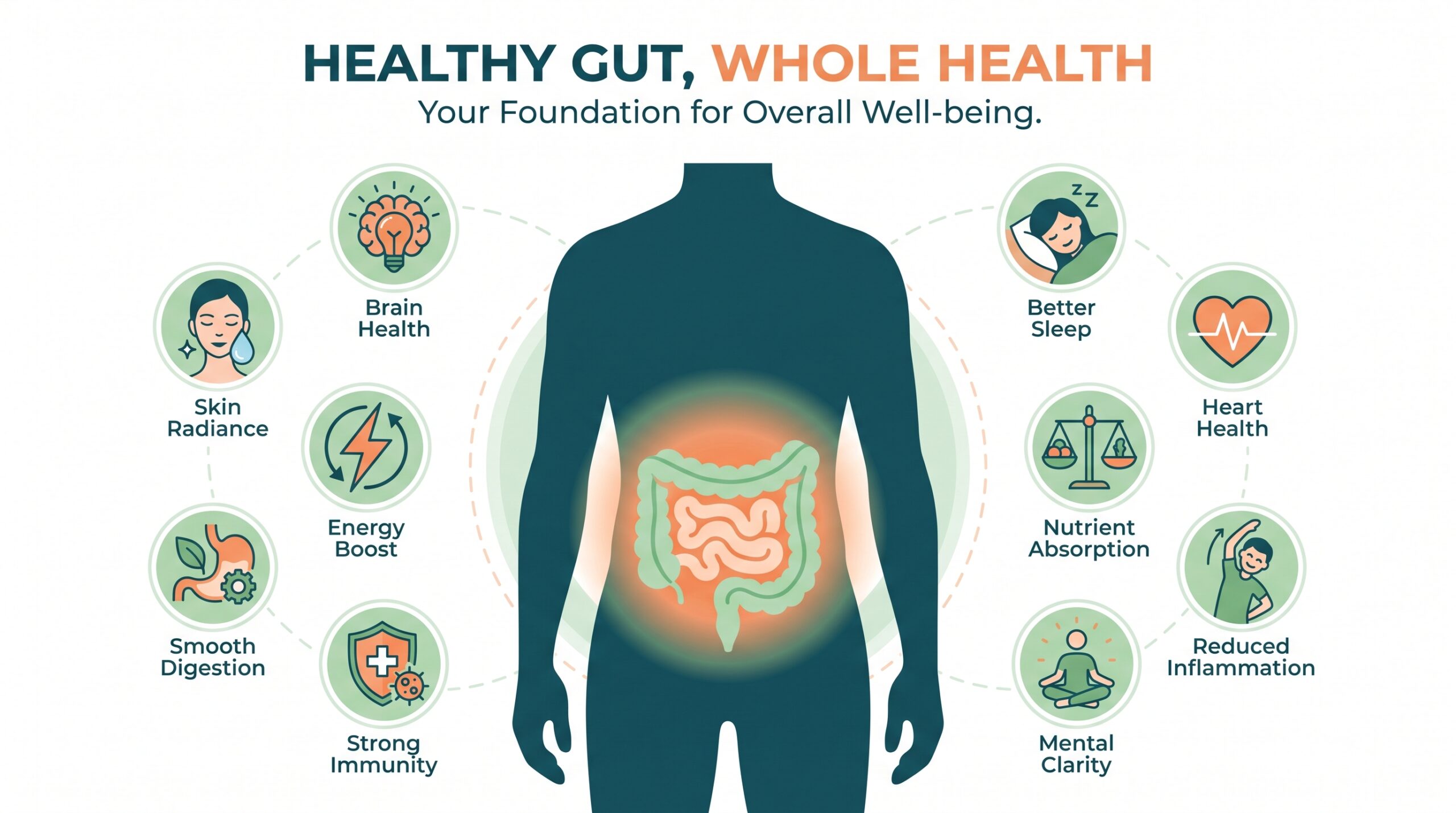
Your gut is home to trillions of bacteria, fungi, and microorganisms that together form the gut microbiome. This ecosystem does far more than digest food. It regulates your immune system, produces key neurotransmitters, influences your hormones, and communicates directly with your brain through what scientists call the gut-brain axis.
Some numbers that put this into perspective:
- Your gut contains over 500 million neurons — more than your spinal cord
- Approximately 95% of your body’s serotonin is produced in the gut, not the brain
- Roughly 70% of your immune system lives in gut-associated lymphoid tissue (GALT)
When the balance of beneficial and harmful bacteria in your gut is disrupted — a condition called dysbiosis — the ripple effects reach virtually every system in your body. The tricky part is that those effects often look like completely unrelated problems.
That persistent headache. The anxiety that appeared out of nowhere. The skin rash that no cream will fix. The weight your body refuses to release.
Your gut could be behind all of it.
10 Signs You Have an Unhealthy Gut
1. You’re Bloated Almost Every Day
Bloating is the most common gut complaint — and the most dismissed. People accept it as their normal, chalk it up to a big meal, and move on. But here’s what I had to learn the hard way: daily bloating is not normal. It is a signal.
When your gut microbiome is imbalanced, certain foods ferment incorrectly in your digestive tract, producing excess gas. The result is that uncomfortable tightness and distension after meals — sometimes even after foods that should be easy to digest, like salad or plain yogurt.
Research published in the journal Alimentary Pharmacology & Therapeutics has linked chronic bloating specifically to small intestinal bacterial overgrowth (SIBO) and microbiome imbalances rather than the foods themselves.
What to watch for: Bloating that begins within 30 to 90 minutes of eating, especially after carbohydrates, dairy, or high-fiber vegetables.
2. Your Bowel Movements Are Inconsistent
This one requires honesty. Most functional medicine practitioners agree that healthy digestion means going to the bathroom between one and three times per day — without urgency, straining, or discomfort. Any significant deviation from that pattern deserves attention.
Chronic constipation, frequent loose stools, or alternating between both are textbook signs of something off in your digestive system. These patterns often trace back to fiber deficiency, bacterial overgrowth, or an inflamed gut lining — all addressable once you identify the root cause.
What to watch for: Fewer than three bowel movements per week, or more than three per day, especially when accompanied by urgency, pain, or incomplete emptying.
3. You Feel Tired No Matter How Much You Sleep
Waking up exhausted after eight hours is one of those symptoms easy to write off as stress or overwork. But when it persists for weeks, your gut deserves investigation.
An imbalanced microbiome can significantly impair the absorption of iron, vitamin B12, and magnesium — all essential for cellular energy production. A compromised gut also interferes with serotonin synthesis, which plays a direct role in regulating sleep architecture and daytime energy levels.
A 2019 study published in Microbiome found measurable gut microbiome disruption in a substantial proportion of patients with chronic fatigue syndrome, suggesting a link far deeper than coincidence.
What to watch for: Fatigue that doesn’t respond to rest, that worsens after meals, or that appears alongside other digestive symptoms on this list.
4. You Have Frequent Mood Swings, Anxiety, or Low Mood
Of everything I discovered in my gut health research, the gut-brain connection surprised me most. We’re conditioned to think of mood as a brain issue — something to address with therapy or medication — while completely ignoring what’s happening below the neck.
The gut and brain communicate constantly through the gut-brain axis: a bidirectional network of nerves, hormones, and immune signals running between your digestive system and your central nervous system. When your gut is inflamed or dysbiotic, those signals can arrive at your brain as heightened anxiety, irritability, low mood, or difficulty concentrating.
Given that 95% of your serotonin originates in your gut, this connection isn’t surprising — it’s almost inevitable.
A landmark review in Nature Reviews Neuroscience described gut microbiota as a key regulator of the stress response system, with measurable influence over anxiety-like behaviors.
What to watch for: Anxiety or low mood that seems out of proportion to your circumstances, particularly when it coincides with digestive symptoms.
5. Your Skin Keeps Breaking Out (And Nothing Seems to Help)
If your skincare cabinet is overflowing and your skin still won’t cooperate, the problem may not be on your face. It may be in your gut.
The gut-skin axis is a well-established concept in modern dermatology. Studies have demonstrated strong associations between gut dysbiosis and inflammatory skin conditions including acne, eczema, rosacea, and psoriasis. When the gut lining becomes compromised, inflammatory molecules can cross into the bloodstream and eventually manifest as skin inflammation.
A 2018 review in the Journal of Clinical Medicine found that patients with acne had significantly lower levels of beneficial gut bacteria compared to clear-skinned controls — suggesting the skin is effectively a mirror of what’s happening inside the gut.
What to watch for: Inflammatory breakouts — particularly along the jawline, cheeks, or forehead — that flare after eating certain foods or during periods of digestive upset.
6. You Get Sick More Often Than the People Around You
Your immune system’s headquarters isn’t in your lymph nodes. A massive portion of it — roughly 70% — lives inside your gut, housed in specialized tissue called gut-associated lymphoid tissue (GALT).
A diverse, balanced microbiome actively trains your immune cells to distinguish between real threats and harmless substances. When that diversity collapses, your immune response becomes slower, less accurate, and more likely to either underreact (letting pathogens in) or overreact (triggering inflammation and autoimmune responses).
If you catch every cold that circulates while others around you stay healthy, or if recovery takes you twice as long as everyone else, your gut immunity is a reasonable place to start looking.
What to watch for: More than three respiratory infections per year, or recovery times that significantly exceed those of the people you live and work with.
7. You Have Unexplained Food Intolerances
Did foods you used to eat your entire life suddenly start making you feel terrible? That’s not just aging, and it’s not bad luck. It’s one of the clearest signs of a gut under stress.
Food intolerances develop when the gut lining becomes inflamed or excessively permeable — a state sometimes called leaky gut or intestinal hyperpermeability. When this happens, partially digested food particles pass through the gut wall and interact with the immune system in ways they shouldn’t. Over time, the immune system begins flagging those foods as threats, triggering reactions that range from bloating and cramping to migraines and fatigue.
Lactose, gluten, and fermentable carbohydrates (FODMAPs) are the most common culprits, but in a truly disrupted gut, almost any food can become problematic.
What to watch for: A growing list of foods that now cause symptoms — especially if that list has expanded noticeably in the past one to two years.
8. You Have Trouble Losing Weight (Even When You’re Doing Everything Right)
Few things are more demoralizing than eating well, exercising consistently, and watching the scale refuse to move. Before you blame willpower, consider the emerging science on gut microbiome and metabolism.
Research has consistently shown that the composition of your gut microbiome influences how efficiently your body extracts and stores calories from food. Specific bacterial strains — particularly from the Firmicutes family — are associated with greater caloric extraction and fat storage, while higher proportions of Bacteroidetes correlate with leaner body composition.
A landmark study by researchers at Washington University found that transplanting gut bacteria from obese mice into lean, germ-free mice caused those lean mice to gain significantly more fat — despite no change in diet. The bacteria alone drove the weight gain.
Two people eating the same meal can have meaningfully different metabolic outcomes based entirely on what’s living in their gut.
What to watch for: Inability to lose weight despite a genuine, sustained calorie deficit — particularly when accompanied by bloating, fatigue, or irregular digestion.
9. You Experience Brain Fog and Difficulty Concentrating
Brain fog is difficult to describe until you’ve experienced it. It feels like thinking through wet cotton — words don’t surface easily, you lose your train of thought mid-sentence, and mental tasks that used to feel effortless now require disproportionate effort.
An unhealthy gut contributes to brain fog through several overlapping mechanisms. Gut-derived inflammation can cross the blood-brain barrier and impair cognitive function directly. Poor gut absorption leads to deficiencies in omega-3 fatty acids, zinc, and B vitamins — all critical for neurological performance. And disrupted serotonin production affects the neurotransmitter balance your brain depends on for clarity and focus.
A 2021 study in Cell found that gut microbiome composition was directly associated with cognitive performance scores in human participants — an increasingly common finding in microbiome research.
What to watch for: Mental sluggishness that’s noticeably worse after meals, peaks in the early afternoon, and occurs alongside digestive symptoms.
10. You Have Constant Sugar Cravings You Can’t Explain
This last sign works in a circular way that’s important to understand — because it’s both a cause and a symptom of gut imbalance at the same time.
Harmful bacteria and yeast strains — particularly Candida albicans — feed on sugar and refined carbohydrates. As they metabolize those sugars, they release metabolic byproducts that actually send chemical signals to your brain mimicking hunger and cravings. So if you find yourself reaching for sweets even when you’re genuinely not hungry, your gut bacteria may be driving that craving more than your appetite is.
Breaking this cycle requires addressing the microbial imbalance first. Willpower alone won’t work if the bacteria keep sending the signals.
What to watch for: Intense cravings for sugar or refined carbohydrates — particularly in the afternoon, after meals, or under stress — that feel compulsive rather than hunger-driven.
How to Start Healing Your Gut (What Actually Works)
Recognizing the signs is the necessary first step. Here’s what the evidence supports for actually shifting the balance back in your favor.
Start with fermented foods daily. Yogurt with live cultures, kefir, sauerkraut, kimchi, and kombucha are all natural probiotic sources that introduce beneficial bacteria directly into your gut. Start with small amounts if your gut is sensitive — too much too soon can temporarily worsen symptoms before improving them.
Add prebiotic fiber to feed the good bacteria. Probiotics need fuel. Foods like garlic, onions, leeks, asparagus, green bananas, and oats contain the prebiotic fibers that nourish beneficial bacteria. Think of it as fertilizing the garden before planting seeds.
Reduce ultra-processed foods and refined sugar. You don’t need to be perfect. But cutting back on artificial additives, preservatives, emulsifiers, and refined sugars removes the primary food source for the harmful bacteria you’re trying to crowd out.
Manage stress consistently, not occasionally. The gut-brain axis runs in both directions — chronic stress measurably disrupts gut function and bacterial diversity. Even ten minutes of daily breathwork, a short walk, or a consistent sleep schedule makes a documented difference over time.
Consider a high-quality probiotic supplement. For many people — especially those with significant dysbiosis — food sources alone aren’t enough to meaningfully shift the microbiome. A quality probiotic that contains multiple clinically studied strains and is third-party tested for potency can significantly accelerate recovery.
💊 Editor’s Pick: Best Probiotic Supplements for Gut Health — our tested recommendations
Prioritize sleep above almost everything else. Your gut microbiome follows a circadian rhythm just like the rest of your body. Even a few nights of poor sleep measurably reduces microbial diversity. Seven to nine hours of consistent, quality sleep is non-negotiable if gut healing is your goal.
When to See a Doctor
Most gut imbalances respond well to dietary and lifestyle changes, especially when caught early. But some symptoms require professional evaluation and should not be managed at home.
See a healthcare provider promptly if you notice:
- Blood in your stool or black, tarry stools
- Unintentional weight loss of more than 5% of body weight
- Severe or worsening abdominal pain that doesn’t resolve
- Symptoms that significantly disrupt your daily life despite several weeks of consistent effort
These may indicate inflammatory bowel disease, celiac disease, colorectal issues, or other conditions requiring medical diagnosis and treatment. Gut health content — including this article — is educational, not a substitute for individualized medical care.
The Bottom Line
Your gut is not just a digestive organ. It’s the operational center of your immune system, a major producer of your mood-regulating neurotransmitters, and a direct communicator with your brain. When it falls out of balance, the signals it sends are often subtle enough to dismiss — but consistent enough to erode your quality of life over months and years.
If you recognized yourself in several of the signs above, the genuinely good news is this: gut health is one of the most responsive areas of the body to positive change. The microbiome is dynamic, not fixed. Small, consistent shifts in diet, sleep, and stress management can produce meaningful improvements within four to eight weeks.
Your gut didn’t fall out of balance overnight. It won’t heal overnight either. But now you know what to look for — and where to start.
References & Further Reading
- Ghoshal UC, et al. “Small Intestinal Bacterial Overgrowth and Irritable Bowel Syndrome.” Journal of Neurogastroenterology and Motility, 2017. PubMed
- Cryan JF, et al. “The Microbiota-Gut-Brain Axis.” Nature Reviews Neuroscience, 2019. PubMed
- Vaughn AR, et al. “Skin-gut axis: The relationship between intestinal bacteria and skin health.” World Journal of Dermatology, 2017.
- Ridaura VK, et al. “Gut Microbiota from Twins Discordant for Obesity Modulate Metabolism in Mice.” Science, 2013. PubMed
- Cryan JF & Dinan TG. “Mind-altering microorganisms: the impact of the gut microbiota on brain and behaviour.” Nature Reviews Neuroscience, 2012.
This article is for informational purposes only and does not constitute medical advice. Always consult a qualified healthcare professional for personal health concerns.







10 Comments